Identification & Dating · Specialist Guide
How to Date Vintage Le Creuset
How old is my Le Creuset?
Dating vintage Le Creuset is a process of comparison rather than a single-mark identification. A base inscription, colour or handle can provide useful clues, but rarely establishes a production date on its own. The most reliable dating comes from combining shape, markings, construction, enamel and documented period references.
One clue
a date
Multiple consistent clues
documentary evidence
a defensible date range
1. Start With the Shape
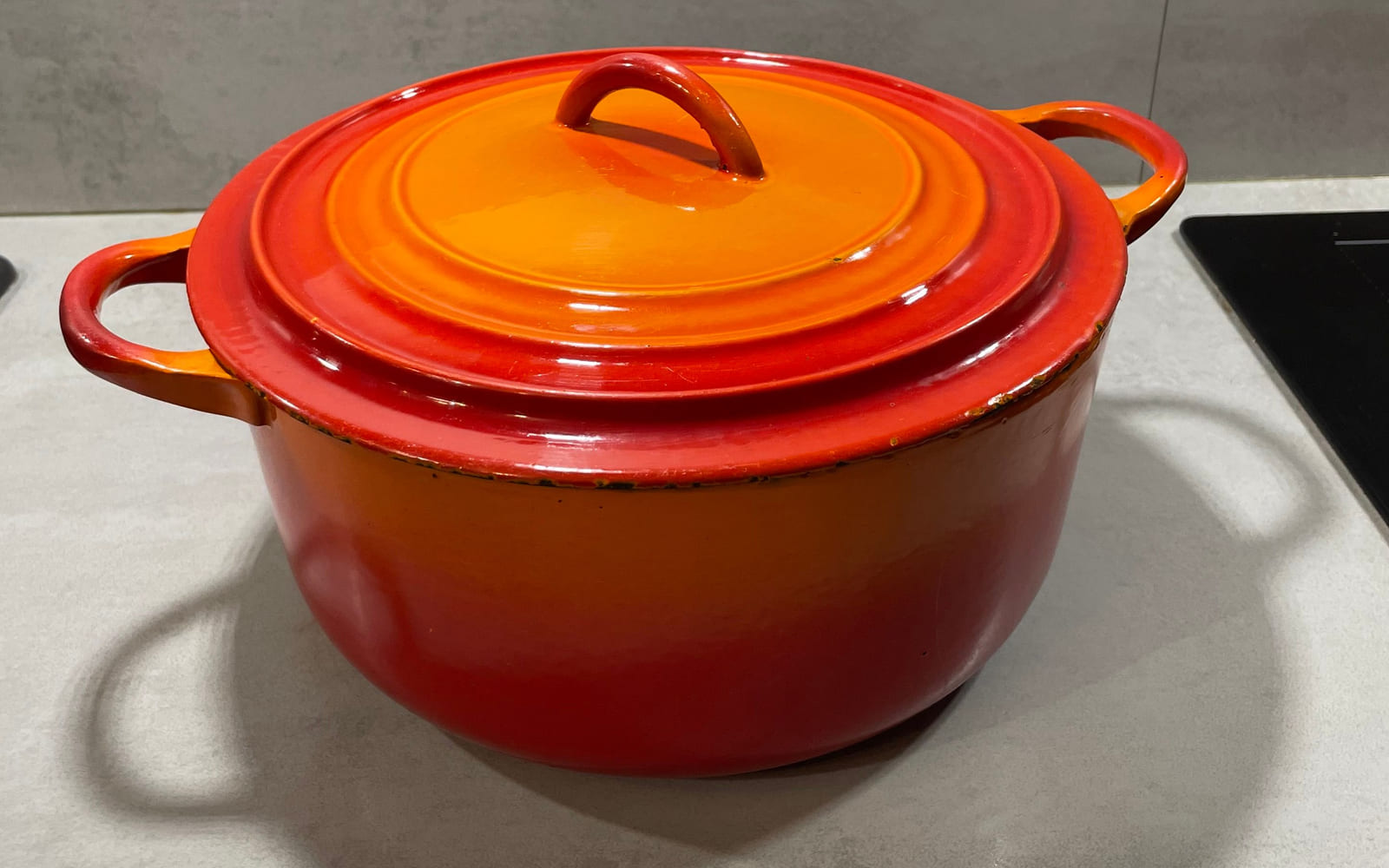
Begin with the object before looking for a logo or trying to name the colour. First decide what kind of cookware is in front of you. A conventional cocotte, a skillet and a designer form were made for different tasks and follow different construction logic; comparisons are useful only when they begin with the correct family of object.
- Round cocotte or Dutch oven
- Oval cocotte
- Saucepan or poêlon
- Skillet or frying pan
- Terrine
- Roaster or baking form
- Special or documented designer form
Record the overall profile, proportions, lid curvature, side-handle form, rim and the relationship between body and lid. Documented catalogues can sometimes show that a particular form was available by a particular date or during a stated range. Visual similarity alone cannot supply that chronology, and a shape used for many years will usually support only a broad conclusion.
A documented early reference
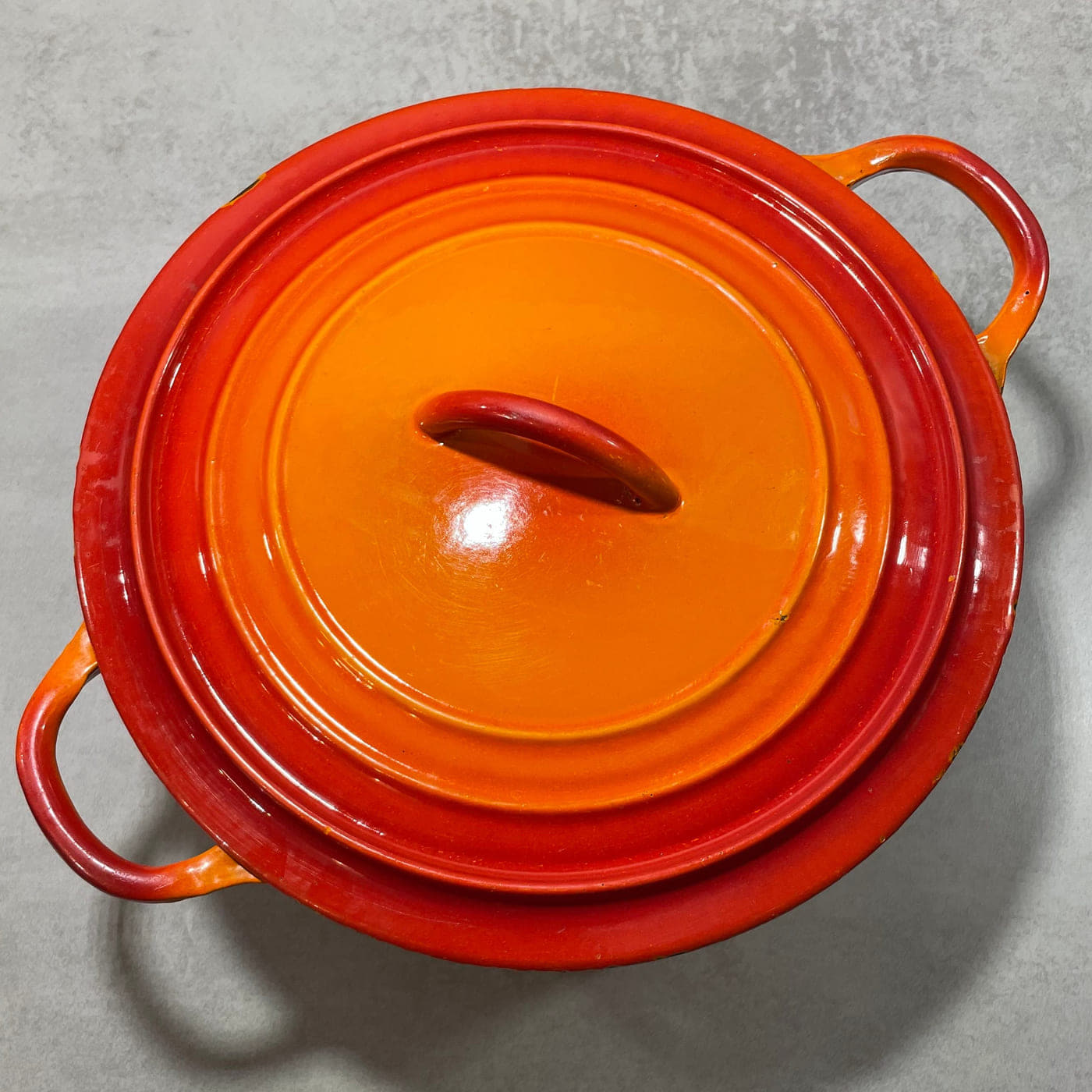
Record the proportions of the body, side handles, lid profile and integral lid handle before interpreting markings or colour.
Le Creuset’s official Archive Series documents the original Cocotte in Volcanique in 1925 and specifically describes its “signature circular lid handle” and red-to-orange gradient. These characteristics provide an important dated reference point for early Round Cocotte construction.
A surviving cocotte sharing these characteristics should not automatically be described as “made in 1925”. The manufacturer source establishes that this design language was documented in 1925; determining the production period of an individual surviving object requires additional evidence.
Shape is the starting point, not the conclusion. The planned Early Cocottes & Shapes guide will add chronological comparisons only when period catalogues or equivalent documentation can be cited.
2. Turn It Over: Examine the Base
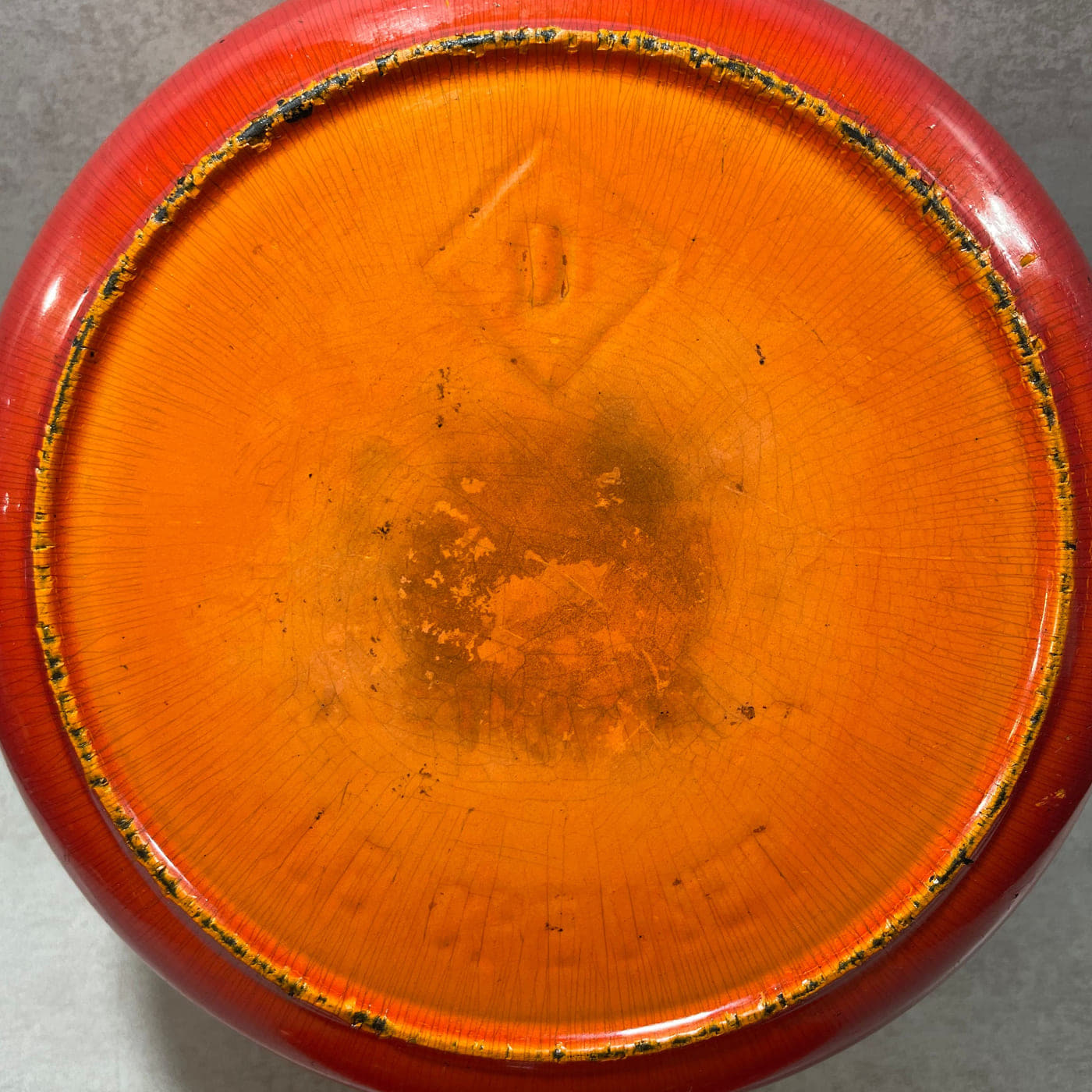
The underside is often one of the most useful areas for vintage Le Creuset identification because it brings construction and markings into the same view. Photograph the complete base in even light before cleaning it aggressively. Then take close views square to the surface so lettering, casting relief and wear remain legible.
What to record
- Enamelled, partly enamelled or exposed cast-iron surface
- Smooth finish, rings and other casting details
- Size or model/reference numbers
- LE CREUSET lettering and its arrangement
- FRANCE, MADE IN FRANCE or other origin wording
- Typography, spacing, orientation and any additional inscription
The base is recorded as a whole before individual marks are interpreted. Finish, casting, wear and markings should be considered together rather than treated as independent date codes.
On this example the photographs record a fully enamelled exterior base in the orange-and-red Volcanique family, wear with enamel losses around the foot, fine surface crazing across the enamel, a lozenge-shaped impressed mark containing a single letter in the centre of the base field, and — in the outer part of the base field, close to the foot — a cast LE CREUSET legend curving with the rim. Those are observations about the surface of the object; none of them is a date.

Subtle cast or impressed marks should be recorded exactly as observed. A letter inside a lozenge is a foundry or mould mark: it records something about how the piece was cast, not the year in which it was cast. Without a documented manufacturer key or a reliably dated comparison, such marks should not be converted into production dates.
Look at the edge of the base, not only its centre
A base photograph framed on the centre of the underside can miss the most important mark on the object. On this cocotte the brand legend is not in the middle of the base: it runs around the outer part of the base field, just inside the foot, in relief so low and in exactly the same enamel colour as its surroundings that it disappears under most lighting. It was missed during the first examination of this piece and was only read once the lower part of the base was photographed and inspected on its own.
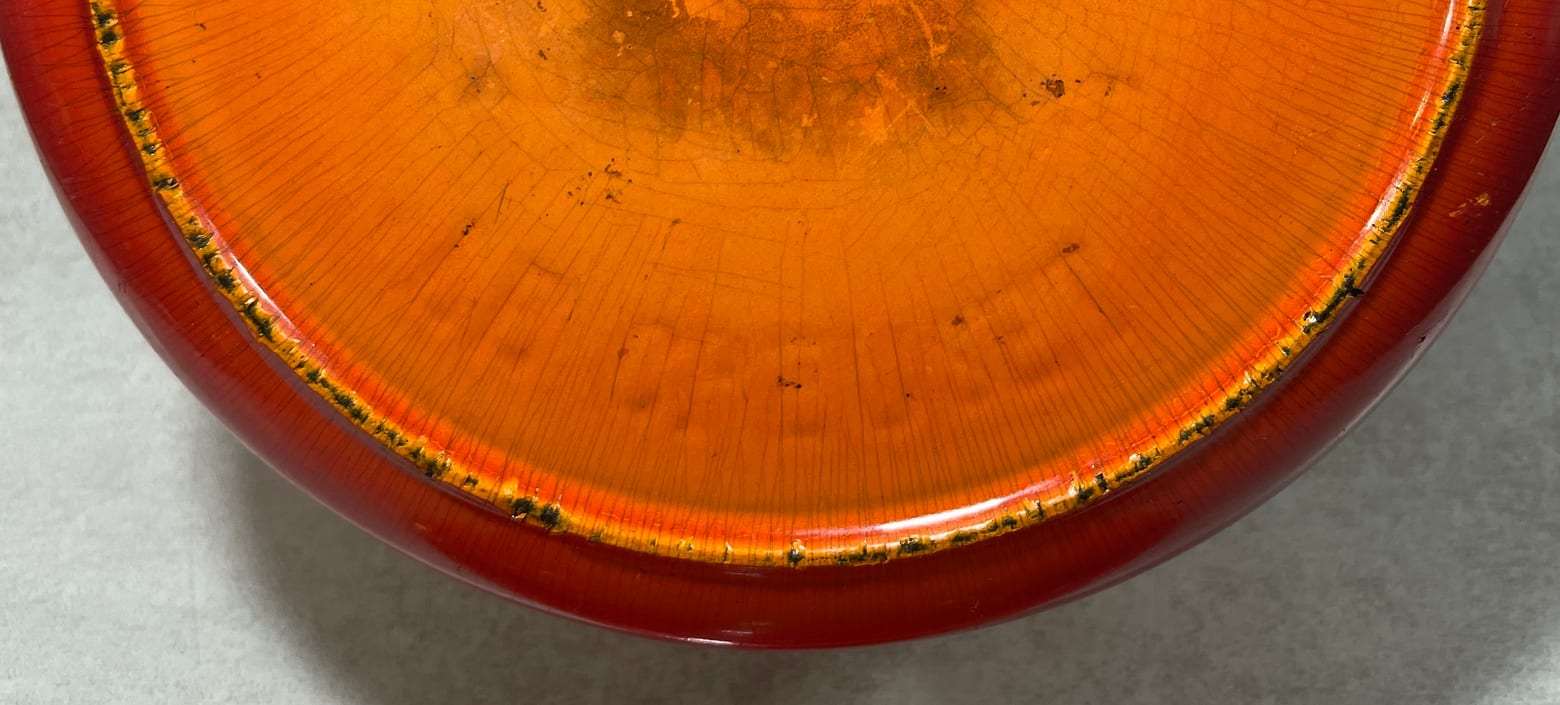
Read in place, the legend spells LE CREUSET in capitals, cast with the vessel rather than stamped or printed afterwards, and curved to follow the foot. It is upside down relative to the lozenge mark higher up the base, which is why the two are easiest to read in separate photographs. This settles the brand attribution on the object itself, instead of leaving it to be inferred from form and colour.
What the base does not carry
Equally worth recording: there is no FRANCE or MADE IN FRANCE origin wording anywhere on the base, no capacity in litres, and no modern-style size or reference number. Absences are evidence too — provided they are reported as absences from these photographs of this object, and not turned into a dating rule for every piece.
A base marking should be interpreted together with the construction of the piece. The presence or absence of a particular inscription should not automatically be treated as an exact production date unless supported by documentary evidence.
3. Read the Markings Carefully
Old Le Creuset markings do not all perform the same function. Separate each element before asking what the group may mean. A brand name identifies the house; origin wording identifies a place of manufacture; a number may refer to a size or model; and typography can provide comparative support. None of those categories is automatically a manufacturing year.
Brand mark
LE CREUSET
Record whether the name is cast, stamped, printed on a label or presented in another documented way, together with its position and orientation. The brand mark identifies Le Creuset but does not, by itself, date the object.
Country of origin
FRANCE / MADE IN FRANCE
Where present and legible, origin wording supports French manufacture. It should not be converted into a precise decade without evidence showing when that exact wording and arrangement were used on the relevant form.
Size or reference
Numbers
Numbers commonly encountered on cookware should first be tested as size or model information. A number is not a year, serial number or date code unless a reliable manufacturer or period source explicitly demonstrates that function.
Comparative evidence
Typography & Layout
Letterforms, spacing and the arrangement of words can support a comparison with reliably dated examples. Similar typography is a clue; a chronology requires multiple documented examples rather than one marketplace attribution.
Transcribe markings exactly, including punctuation, line breaks and uncertain letters. A close photograph is preferable to a modernised transcription because small differences may later matter. We have not found a universal Le Creuset date-code system in the official sources consulted for this guide, so we do not reinterpret ordinary size or reference numbers as hidden dates.
Marks on the Cook & Collect example
This example carries a cast LE CREUSET legend curving around the outer base field, a lozenge-shaped impressed mark containing a single letter in the centre of the base, and an impressed letter beneath the lid. The legend establishes the brand; the letters are recorded as physical evidence and are not interpreted here as manufacturing date codes.
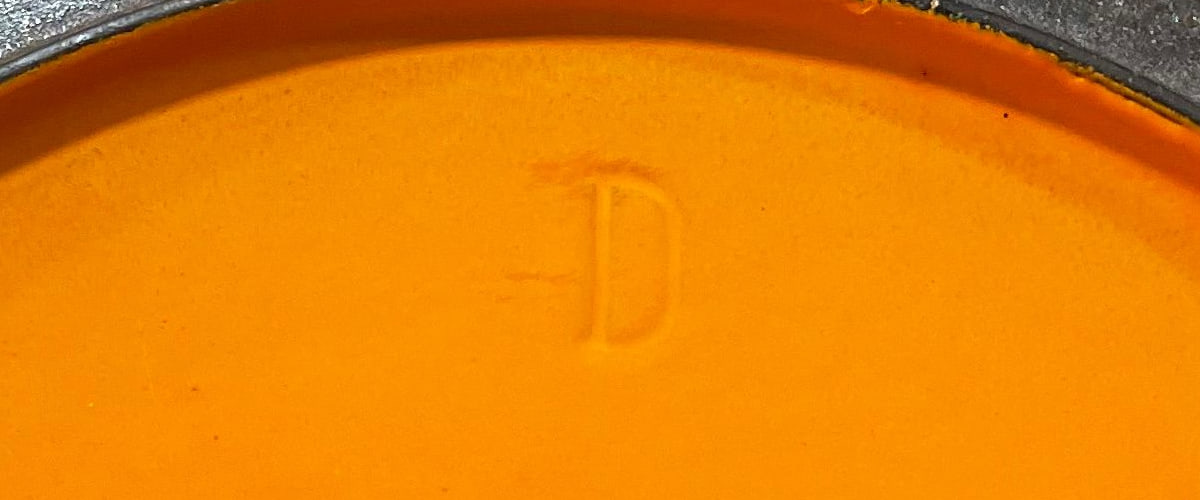
The brand legend and the origin wording are two separate records and are noted separately. Here the first is present and the second is absent, and both facts are carried into the case study below.
Vintage Le Creuset marks timeline — research in progress
This space is reserved for a future chronology built from dated catalogues, advertisements and original examples. It will not be populated with rules such as “this logo means the 1950s” unless a source establishes that relationship for the relevant object type.
4. Examine the Handles and Lid Handle
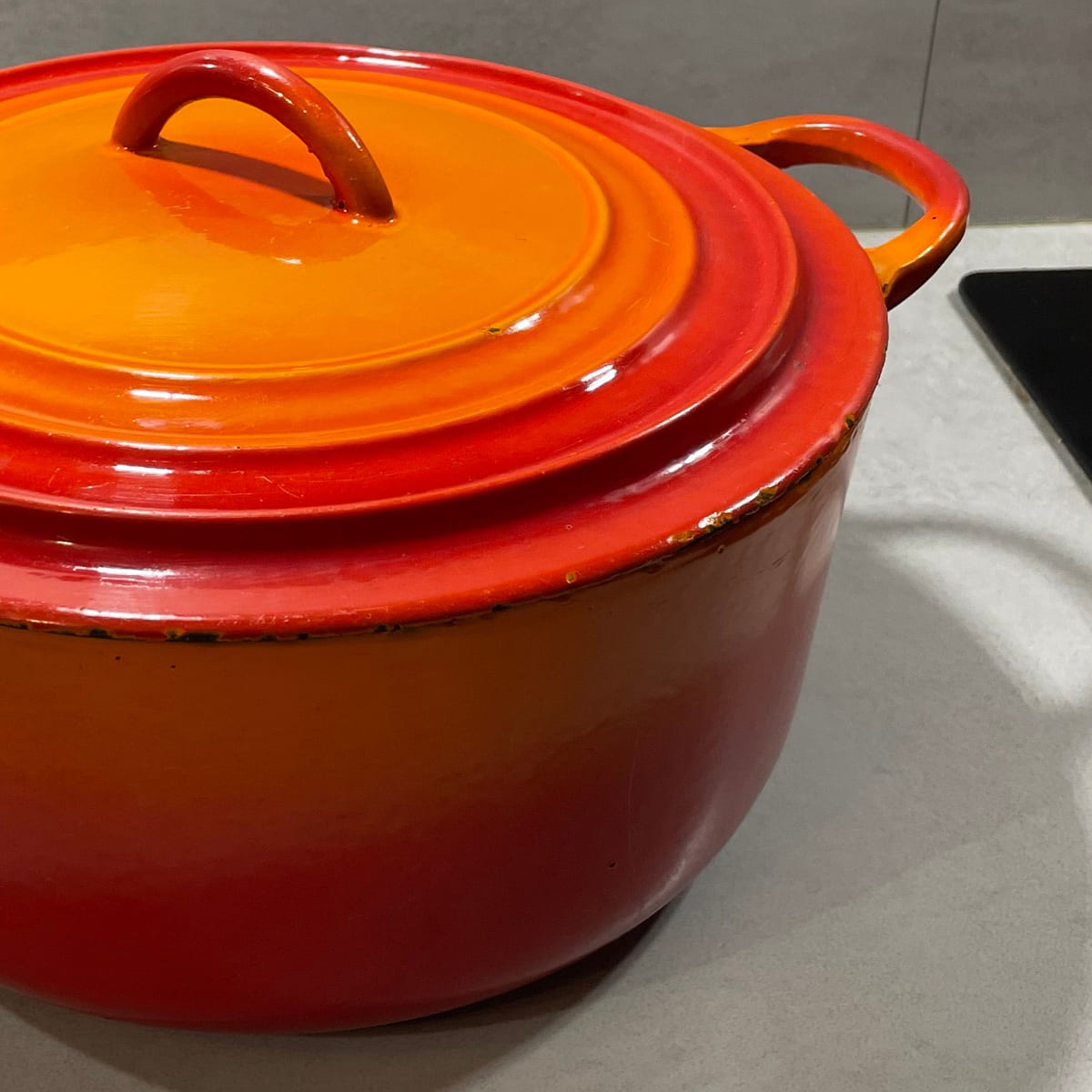
Handles are part of the cast form or of an attached construction, so they can help distinguish object families, specific designer pieces and changes between documented versions. Examine all of them as engineered features rather than decoration: the side handles of a cocotte, the long handle of a saucepan or skillet, and whatever the lid is lifted by — an integral cast handle on some cocottes, a separately attached knob on others.
Construction before material
For cocottes, record the shape, size, thickness and projection of the side handles and how they merge with the body. For saucepans and skillets, record whether the long handle is cast iron, wood, phenolic material, metal or another documented construction, and how it is fixed. Compare proportions as well as material: similar materials can appear across long periods.
For the lid, photograph the top, the profile and the attachment. Where the lid is lifted by a separate knob, phenolic, metal and cast constructions may provide useful comparative evidence — but a knob is also one of the easiest components to replace after wear, damage or a change in use. Where the handle is cast as part of the lid, record its section, height and how it meets the surface instead.
Integral circular lid handle
Unlike a replaceable central knob, the handle on this example is integral to the cast-iron lid. Le Creuset’s Archive Series specifically identifies a circular lid handle as a characteristic of its original 1925 Cocotte in Volcanique.
This makes the construction an important early documentary comparison, but it does not establish that this individual example was manufactured in 1925.
Where a cocotte is lifted by a separate knob, that knob can make an older piece appear newer — or the reverse — because it is among the easiest parts to replace. Whether a lid carries an integral cast handle or an attached knob, the lid fitting should never be the sole dating criterion.
5. Study the Lid
A lid should be examined as a separate object and then as part of the vessel. Record its profile and curvature, rim construction, the way its handle or knob is formed or attached, the underside, internal features, casting marks and fit. The way the lid meets the body can be as informative as the visible top surface.
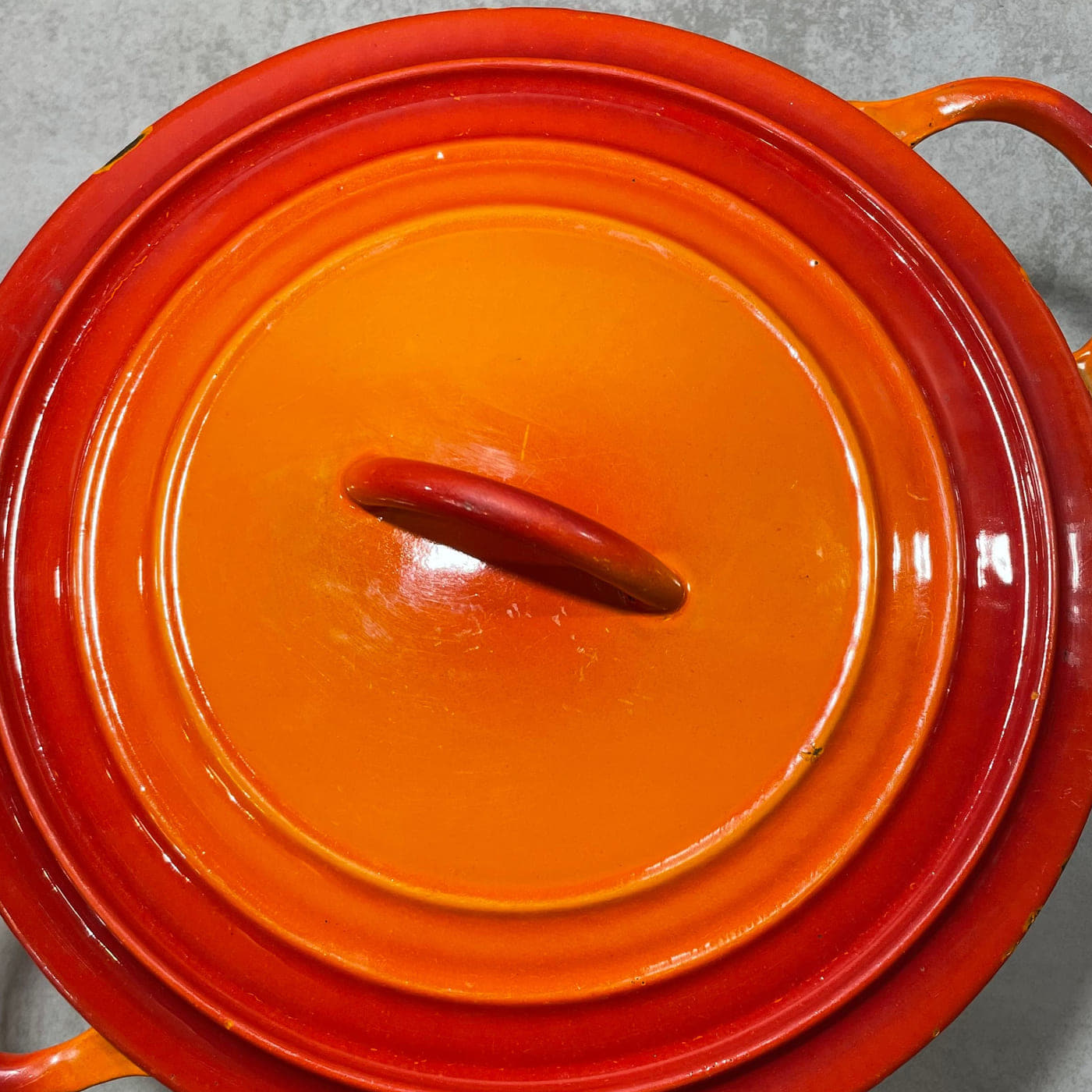
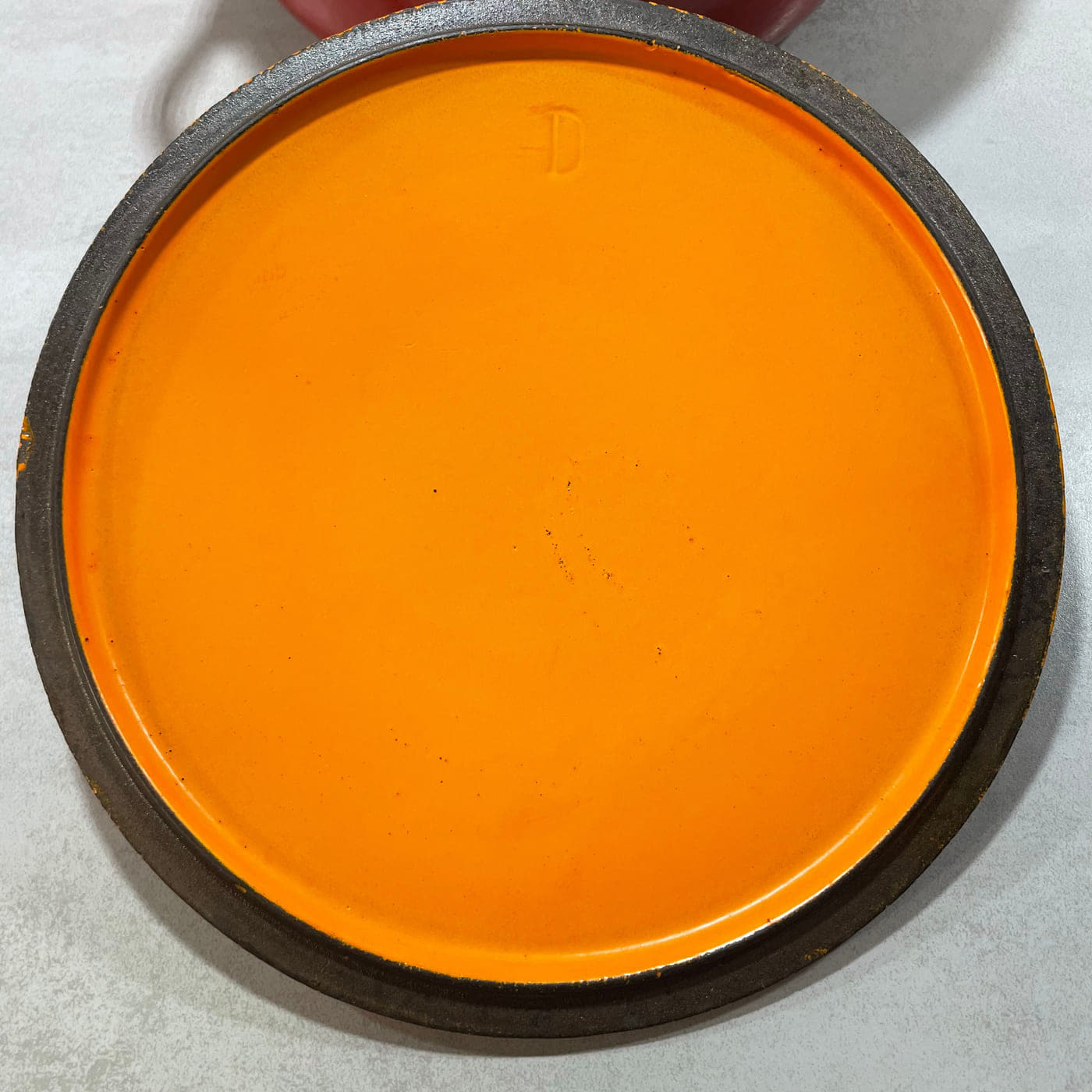
One lid, two sides
The exterior records the lid profile, enamel treatment and handle construction. The underside records the rim, interior enamel, casting details and marks. Both sides should be examined before the lid is used as dating evidence.
Check whether body and lid share compatible proportions, enamel, wear and construction. A lid may have been replaced with another compatible example, or two separated parts may have been paired later. That does not make the vessel uninteresting, but it changes how the lid can be used as evidence.
On the Cook & Collect example, body and lid appear visually coherent in enamel family, wear and construction. That is an observation, not proof: nothing in these photographs establishes that this lid left the foundry with this body, and the documentary comparison below does not settle the question either.
Before using a lid to date a cocotte, establish that the body and lid form a coherent pair. If their evidence conflicts, describe the mismatch rather than forcing a single date.
6. Identify the Colour and Enamel
Colour is central to Le Creuset’s history. Official archives document Volcanique from 1925, later colour developments, the vertical-gradient Rayure collection in the 1950s and other named finishes. Those records make colour valuable evidence when an observed finish can be matched carefully to a documented one.
Read the surface cautiously
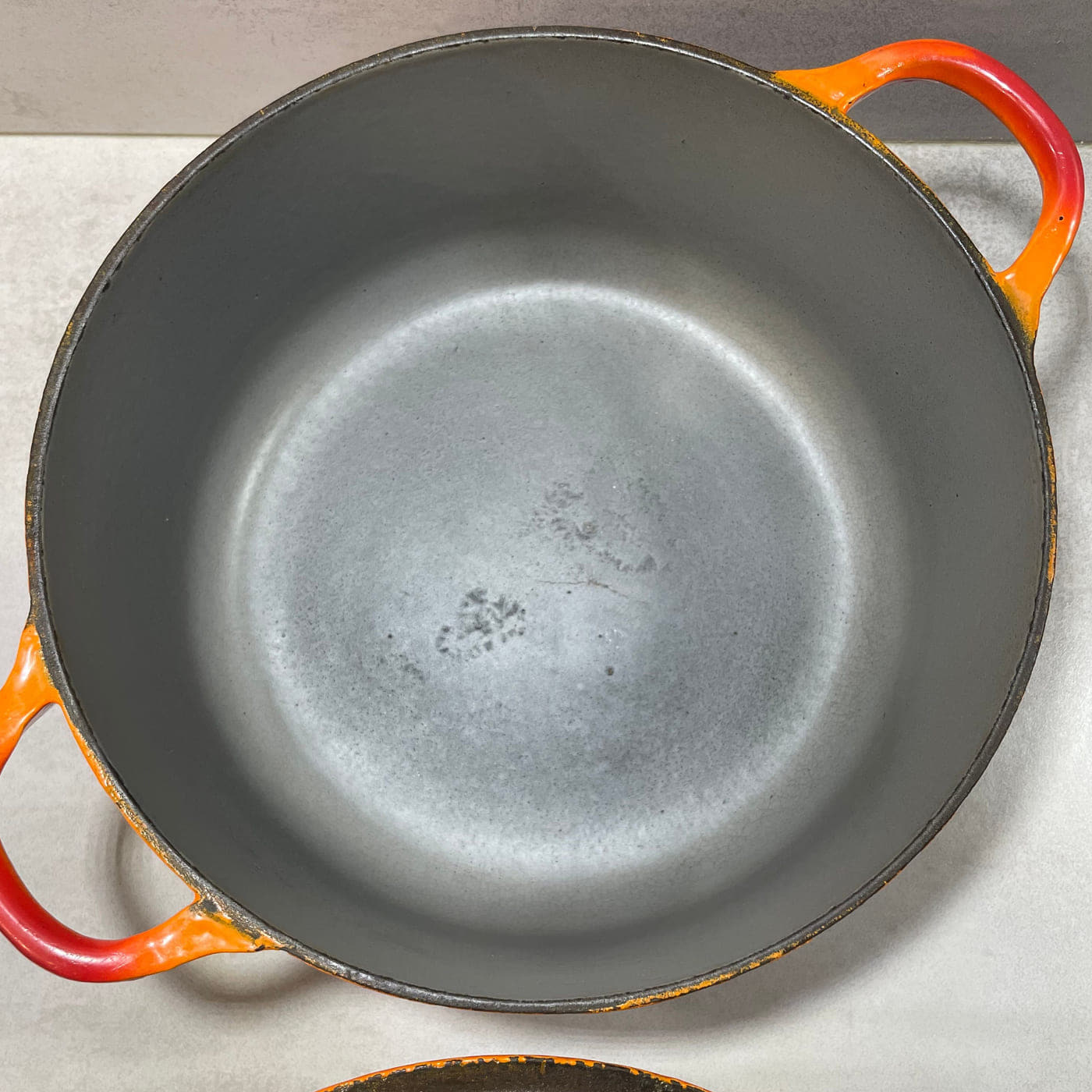
First describe what is physically present: exterior hue, gradient direction, interior enamel, gloss or satin appearance, edge wear, staining and repairs. Then compare it with a source. Colour can sometimes establish an earliest plausible period or support an attribution, but a long-running colour should not normally be used to assign a precise production year.
Photographs introduce another layer of uncertainty. Daylight and artificial light change hue; camera processing and screens shift colour; enamel darkens or stains; and marketplace images may be heavily edited. Whenever possible, compare the object in neutral light and include a close view of the enamel surface.
Vintage Le Creuset Colours & Enamels guide coming soon
Volcanique as a documented reference
Le Creuset documents Volcanique from its original 1925 Cocotte and describes its characteristic red-to-orange gradient. The exterior finish of the Cook & Collect example is consistent with this historic colour family.
Volcanique continued beyond the company’s first year, so colour supports the identification but cannot provide an exact manufacturing date.
Colour is supporting evidence, not automatically a date. A colour name should be used only when the match to manufacturer or period documentation is defensible.
7. Understand the Numbers
Numbers on vintage Le Creuset pieces are a common source of confusion. Depending on the documented object, a cast number may relate to size, diameter, capacity, model or another production reference. Its meaning must be established for that form rather than assumed from the digits alone.
A number should not automatically be interpreted as a manufacturing year, production date, serial number or Le Creuset date code. For example, a number that corresponds to a vessel’s nominal diameter is useful for identifying its size, but it says nothing about age unless a dated catalogue also links that exact size, form and construction to a period.
No universal date-code claim
The official sources consulted for this guide do not provide a universal system by which ordinary numbers on vintage Le Creuset cookware can be decoded into years. We therefore record the number first and assign its function only when documentation supports it.
A verified size chart can be added later from period catalogues and manufacturer documentation. Until enough sources are assembled, this guide will not publish a complete mapping assembled from unattributed online charts or seller descriptions.
8. Compare the Piece With Documented Examples
The final step is documentary comparison. Search for the same combination of form, handle, lid, base arrangement and enamel rather than one matching detail. Sources do not carry equal weight, so record what each source actually establishes and whether it shows a design date, a production range, an advertisement date or only a seller’s attribution.
- Manufacturer archives
- Period Le Creuset catalogues
- Period advertisements
- Museum collections
- Published design references
- Reliably documented surviving examples
- Auction and marketplace examples, used only as supporting comparison
A museum record can be especially valuable for a documented designer object, while a period catalogue can establish that a form was offered by a given date. Marketplace listings can reveal surviving variants or lead to a brochure, but their titles and dates are not primary evidence and may repeat earlier unsupported claims.
Documented reference — 1925
Le Creuset’s official Archive Series identifies the original Cocotte in Volcanique in 1925 and specifically describes its circular lid handle and red-to-orange gradient.
The Cook & Collect example documented on this page shares these broad characteristics. The comparison establishes a documented early design reference; it does not prove that this individual vessel was manufactured in 1925.
A seller describing a cocotte as “1950s” does not establish that date. The attribution becomes significantly stronger when the same form, handle, markings and finish can be matched to a period catalogue, advertisement or manufacturer archive.
Putting the Clues Together
The objective is usually not an exact year. For many pieces, the most responsible result is a range such as “circa the 1960s,” “late 1960s–1970s,” or “produced no earlier than” a documented reference point. These are forms of conclusion, not dates to apply generically: the evidence for the individual object must determine which wording is justified.
State which observations support the range and which remain uncertain. If a catalogue documents the shape but not the base mark, say so. If a knob appears replaced, remove it from the dating argument. If the evidence supports only “vintage Le Creuset, period not established,” that is a valid conclusion and a better one than invented precision.
For the Cook & Collect cocotte examined on this page, a LE CREUSET legend cast into the base settles the brand, while the early round form, integral circular lid handle and Volcanique-family gradient can be compared with Le Creuset’s documented 1925 design reference. Together with what the base does not carry, those clues support a working range rather than a year; none of them alone establishes the manufacturing date of the surviving object.
A defensible range is transparent: another researcher should be able to see the object features, consult the cited comparison and understand how the conclusion was reached.
Dating Examples From the Cook & Collect Archive
The following case studies apply the method above to objects handled and photographed by Cook & Collect. Each conclusion separates what can be observed on the object from what can be established through documentary comparison.
Dating Example No. 01
Early Round Cocotte in Volcanique
Evidence record
- Object
- Le Creuset round enamelled cast-iron cocotte.
- Shape
- Deep round body with relatively slender loop side handles and a fitted cast-iron lid.
- Base
- Fully enamelled exterior base in the Volcanique colour family, with substantial age-related wear, fine crazing throughout, and a lozenge mark containing a letter in the centre of the base field.
- Markings
- A lozenge-shaped impressed mark containing a single letter on the base, and an impressed letter beneath the lid. Recorded as physical evidence; not interpreted as manufacturing date codes.
- Brand legend
- LE CREUSET, cast in capitals in the outer base field and curved to follow the foot. Cast with the vessel, not stamped or printed afterwards.
- Origin wording
- None. No FRANCE or MADE IN FRANCE on the base, no capacity in litres, and no modern-style size or reference number.
- Handles
- Two integral cast side handles. The lid uses an integral circular/arched cast-iron handle rather than a separately attached central knob.
- Lid
- Stepped/concentric upper profile with integral cast handle. The underside records the rim construction, enamel and a visible D mark whose function has not yet been established.
- Colour / enamel
- Red-to-orange graduated exterior consistent with the historic Volcanique colour family, with a grey enamel vessel interior.
- Dimensions
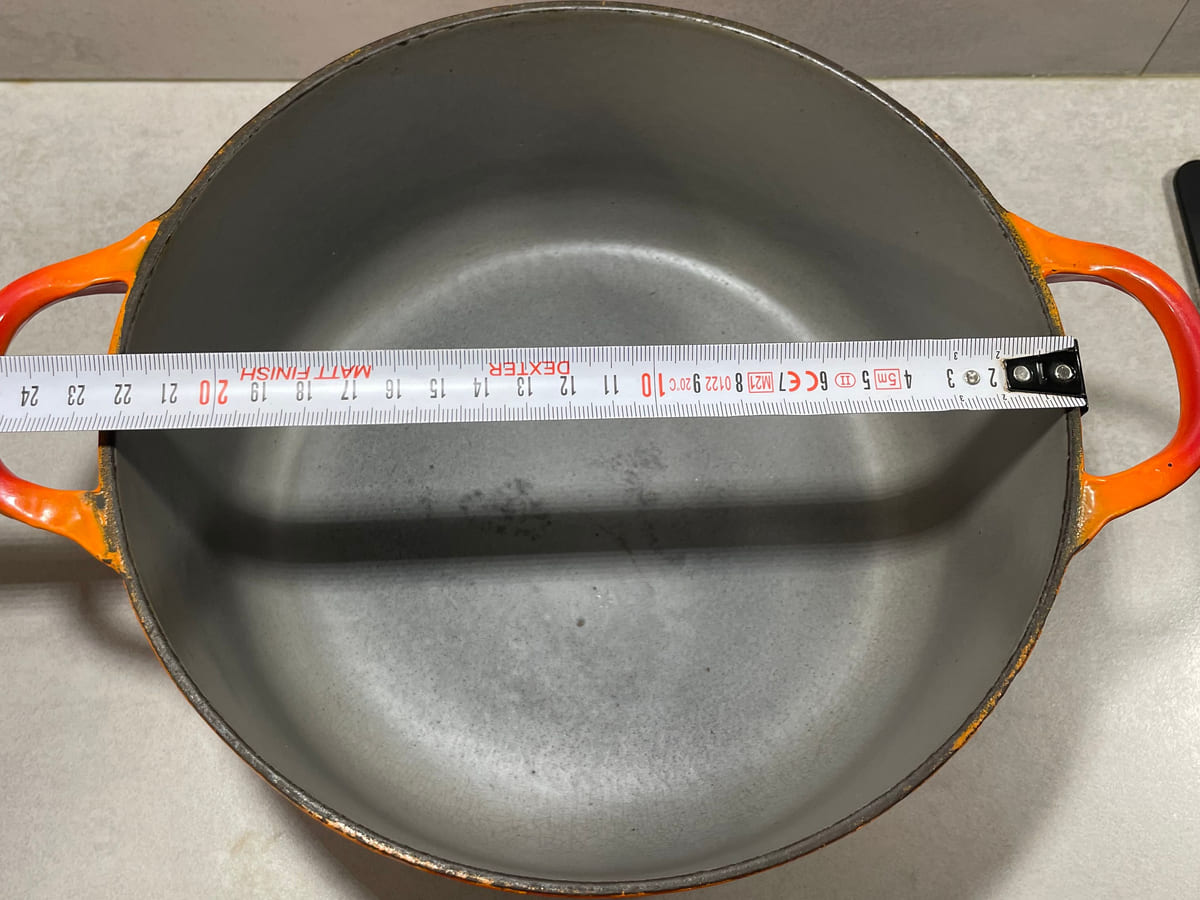
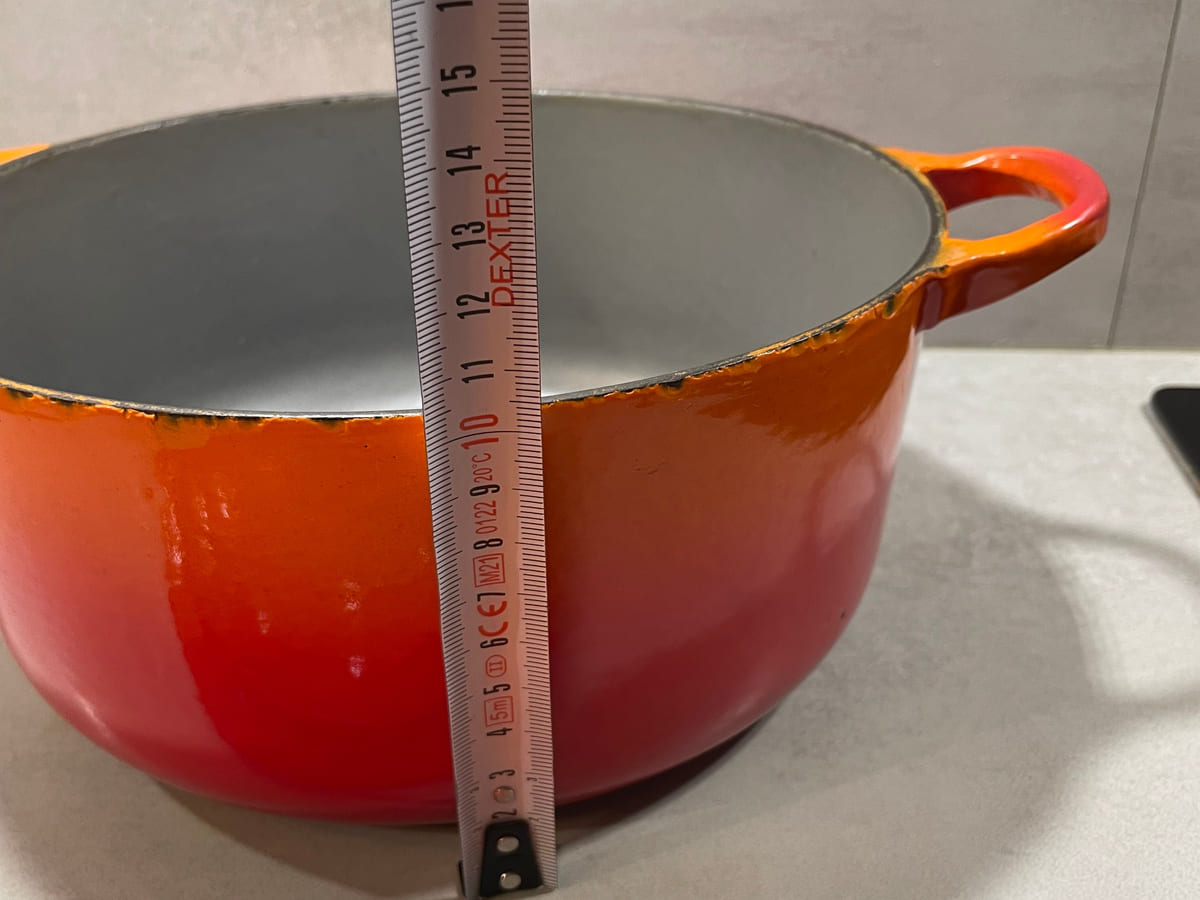
- Diameter and body height are recorded in the Cook & Collect research photographs below. The tape reads approximately 22 cm across the rim, excluding the side handles, and approximately 10.5 cm of body height without the lid. Both are readings taken from those photographs and are to be confirmed by direct measurement before being published as exact dimensions. Handle-to-handle width has not been measured.
Documented comparison
Le Creuset’s official Archive Series identifies the original Round Cocotte in Volcanique in 1925. The manufacturer specifically describes a signature circular lid handle and a red-to-orange gradient.
The Cook & Collect example shares these documented characteristics, providing strong evidence that its design belongs to the early/original Round Cocotte tradition. The manufacturer reference establishes the design by 1925; it does not establish the production year of this individual surviving vessel.
Dating conclusion & why
- Design reference
- The original Cocotte design Le Creuset documents in 1925 — round form, integral circular lid handle, red-to-orange Volcanique gradient. That dates a design, not a date of manufacture.
- Working date range
- Estimated between 1925 and about 1950 — an inference drawn from the markings, not a documented production range.
- Conclusion
- Early Le Creuset Round Cocotte, brand confirmed by the cast base legend. Design generation documented from 1925; the individual production year remains unestablished.
- Why
- The brand is no longer an inference: LE CREUSET is cast into the base of this vessel. The round form, integral circular lid handle and Volcanique gradient match the characteristics Le Creuset documents for its original 1925 Cocotte, which places the earliest plausible point of the range at that design. The upper end is put at roughly 1950 because the base carries the name alone — no origin wording, no capacity in litres, no modern-style reference number — a plainer set of markings than the FRANCE and MADE IN FRANCE bases that are commonplace on later export-era pieces. That is a comparison of markings, not a documented cut-off, which is why the bound is written as approximate.
- Evidence level
- Brand: documented on the object · Date: probable range, upper bound approximate
The brand attribution rests on a mark cast into the object itself. The 1925 lower bound rests on a manufacturer-documented design. The mid-century upper bound rests on the absence of origin wording and capacity marking: a reasonable inference, but not yet supported by a dated catalogue, advertisement or archive record.
How firm is the 1950 end of the range?
Less firm than the 1925 end, which is why it is written as “about”. No source consulted for this page establishes the year in which Le Creuset began adding FRANCE or MADE IN FRANCE to its bases, or the year it stopped issuing bases marked with the name alone. Origin wording is generally driven by export requirements, so a base without it is as consistent with a piece sold on the French domestic market as it is with an early one.
The range is therefore published as a working conclusion open to correction: it will be narrowed, moved or withdrawn as soon as a dated catalogue, advertisement or archive record shows when these base markings were in use. Nothing here should be quoted as evidence that Le Creuset dated its own production this way.
Evidence labels used in these examples
- Documented
- The conclusion is directly supported by a relevant primary or institutional record.
- Strongly supported
- Several consistent object features match reliable dated documentation.
- Probable
- The available evidence points to the conclusion, but a material documentary gap remains.
- Approximate
- Only a broad range is supportable and uncertainty is substantial.
These labels describe the quality of evidence, not a numerical confidence score. Each label must be accompanied by the observations and sources that justify it.
Common Mistakes When Dating Vintage Le Creuset
- Dating a piece from colour alone
- Assuming the number on the base is the manufacturing year
- Assuming every knob is original to the lid
- Assuming every compatible lid originally belonged to the body
- Treating a marketplace seller’s stated date as documentary proof
- Assuming MADE IN FRANCE alone establishes a precise period
- Treating one characteristic as definitive
- Confusing a later documented reissue with original-period production; a reissue should be identified only when evidence supports it
Questions About Le Creuset Age & Identification
How old is my Le Creuset?
Start by recording its shape, base, markings, handles, lid and enamel, then compare that combination with dated archives or catalogues. Without a documentary match, a broad period—or no established period—is more responsible than an exact year.
How can I tell if my Le Creuset is vintage?
Vintage identification depends on a consistent group of construction and documentary clues. Age cannot be established from patina, colour or one old-looking component alone.
Can you date Le Creuset from the markings?
Markings can support identification and comparison, but this guide does not use a universal logo chronology. An exact period requires the same marking arrangement to be documented on a relevant dated object or source.
What do the numbers on vintage Le Creuset mean?
They may describe size, model or another reference depending on the piece. They should not be read automatically as a year, serial number or date code.
Does the colour tell you how old Le Creuset is?
A documented colour can support a period or establish an earliest plausible date, but long-running finishes and inaccurate photographs prevent colour from providing an exact year by itself.
Does “Made in France” date a Le Creuset piece?
It supports country of manufacture. On its own, it does not establish a precise production period.
Can the lid handle or knob help date a cocotte?
It can provide supporting evidence when it is original and documented. Record whether the lid is lifted by a handle cast as part of the lid or by a separately attached knob, because a knob is easily replaced. Either way, the lid fitting must never be the sole dating criterion.
Research & References
These sources provide documented examples of Le Creuset history, colours, forms and designer objects. They do not supply a universal dating key. This guide uses them only for claims they actually support, and the list grows as further period catalogues, advertisements and original case studies are added.
- Source used for the case study
- Le Creuset Canada, “The Archive Series: The Round Dutch Oven”, 8 April 2025.
Official manufacturer archive documenting the original 1925 Cocotte in Volcanique, including its circular lid handle and red-to-orange gradient, as well as later milestones in the Round Dutch Oven lineage. It dates a design, not individual surviving objects. Its “1925-1945” heading is followed by text describing the 1950s, so that heading is not used here as evidence of a production range. The photographs on that page are Le Creuset’s and are not reproduced. - Official Le Creuset archives and heritage material
- Manufacturer sources consulted for the company chronology and selected documented designs, skillets, colours and forms.
- Period documentary references
- Dated period material consulted for the Le Creuset research cluster and relevant to early cocottes. These records establish what was commercially documented at a given date; they do not date an individual surviving object.
- Le Creuset (Société Anonyme), Fonderies – Émailleries, Fresnoy-le-Grand, February 1935, 23 pp.
Illustrated trade catalogue documenting Le Creuset culinary cast iron, including early cookware forms and the Volcanique, Royale, Eureka and decorative ranges. Alain Brieux catalogue record - Fonderies et Émailleries Le Creuset — advertising blotter, 1933. Familistère de Guise, inventory 2006-29-1.2.
Institutionally preserved period advertising documenting the early Le Creuset range. The linked modern Familistère publication catalogues and reproduces the original blotter; it is not itself a Le Creuset catalogue. Familistère publication, PDF page 70
- Le Creuset (Société Anonyme), Fonderies – Émailleries, Fresnoy-le-Grand, February 1935, 23 pp.
- Museum collection
- Centre Pompidou’s record for Raymond Loewy’s Coquelle demonstrates how an institutional entry can document maker, designer, material and dates for a specific design without dating every related surviving object.
- Research in progress
- Further period catalogues and advertisements will be added as they are located and checked, and the case studies above will be revised whenever a source narrows or corrects a conclusion. Until then, no missing chronology is filled from unattributed charts, forum posts or repeated marketplace descriptions.
Continue the Le Creuset Research
For the design chronology, designer collaborations and overview of the planned research cluster, return to Vintage Le Creuset — the main guide.
Future specialist guides will examine Vintage Le Creuset Colours & Enamels, Raymond Loewy and Coquelle, Enzo Mari and La Mama, skillets, Rayure, and early cocottes and shapes. They remain unlinked until each page is researched and published.