E. Dehillerin · Collector’s Guide
E. Dehillerin Copper Cookware: Marks, Construction & Dating
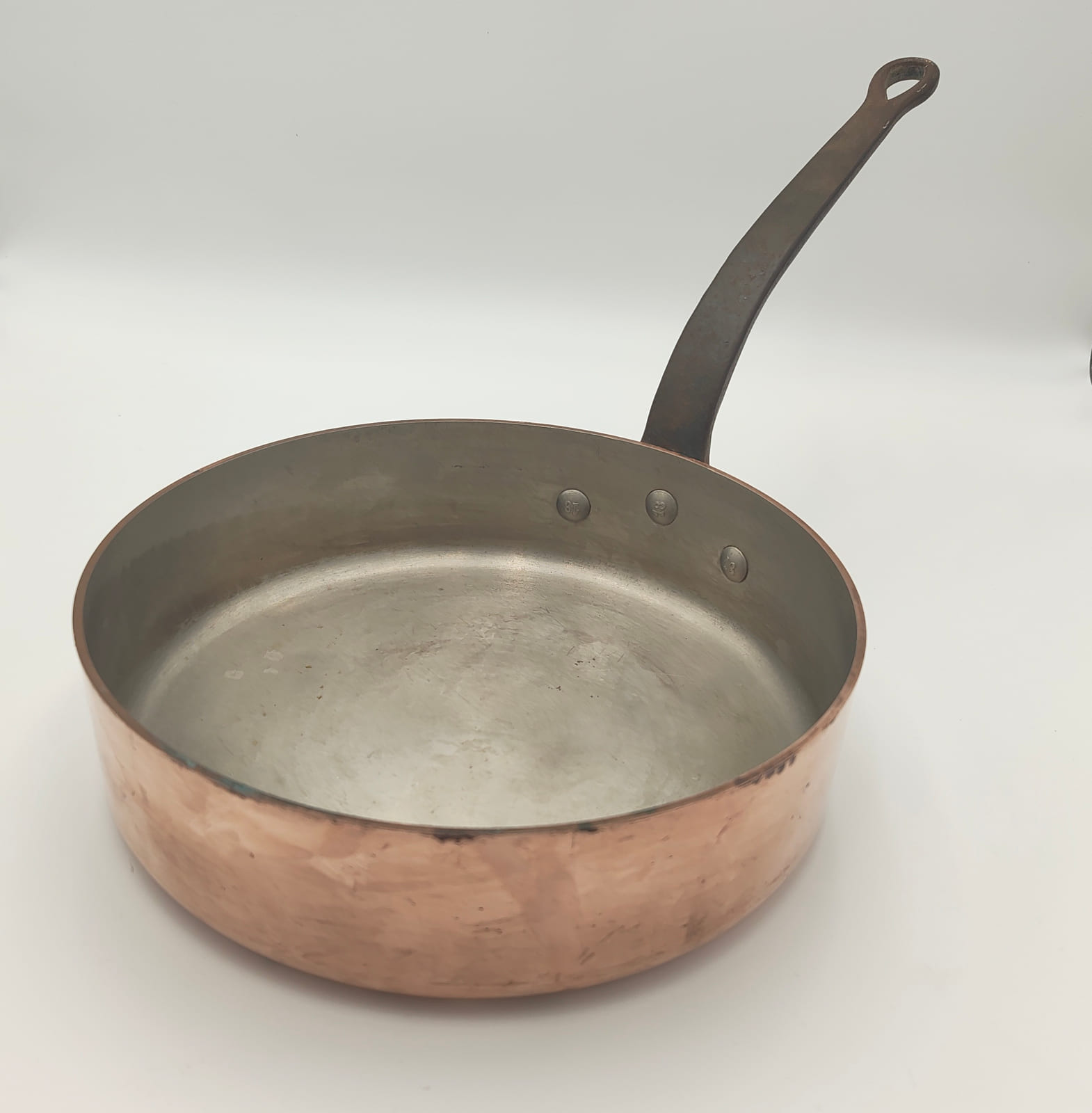
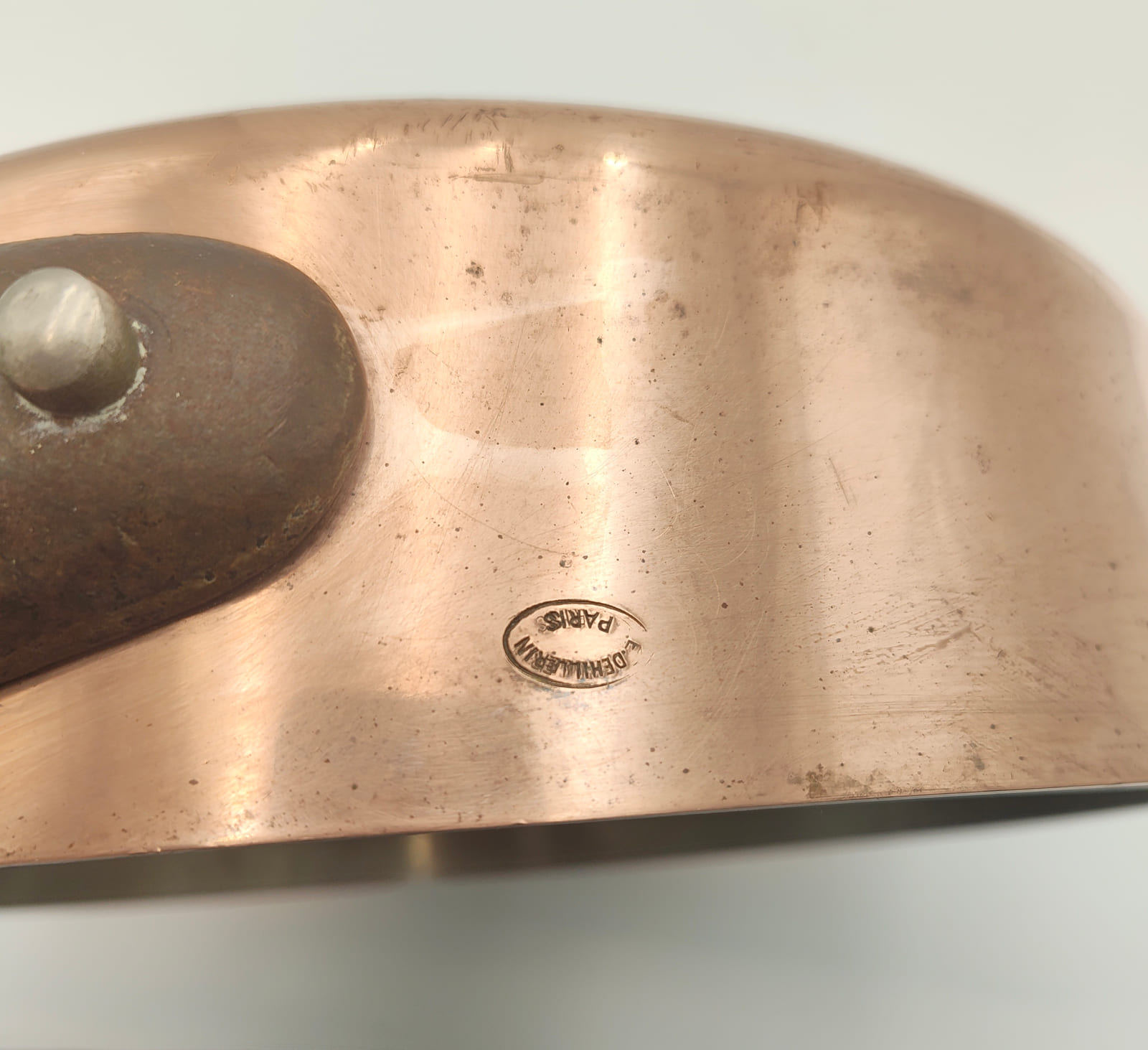
An “E. DEHILLERIN / PARIS” mark is one of the most recognisable things a collector can find on French copper, and one of the most frequently over-interpreted. This guide sets out what the mark establishes, what it does not, and how the rest of a piece — gauge, weight, handle, rivets and lining — should be read alongside it. It is built around a heavy tinned copper sauté pan measured and weighed by Cook & Collect, and it forms part of our wider guide to vintage French copper cookware.
E. Dehillerin and Professional French Cookware
According to the firm’s own published history, E. Dehillerin has its origins in the Halles district of Paris, where Eugène de Hillerin acquired a hardware and household goods store and a boilermaker’s workshop during the 1880s, together with a set of complementary businesses that included a tinning workshop and an older shop opened in 1820 — the date the house now dates its bicentenary from. In 1890 the shop moved to rue Coquillière, where it still stands.
One detail of that history matters a great deal when reading a Dehillerin mark. The same source records that manufacturing was concentrated in workshops in the 15th arrondissement, where copper and tinned cookware was made for restaurants and where tinsmiths, scourers and scrapers worked until the 1960s. E. Dehillerin was therefore both a supplier of professional kitchen equipment and, historically, a producer in its own workshops. That is precisely why an “E. DEHILLERIN / PARIS” mark should be treated as identifying the house associated with the object rather than as a shortcut to a single workshop or a production year.
Retailed by, or made by?
Because the house both supplied and produced, the safest description of a marked piece is that it was retailed by E. Dehillerin. That wording is accurate in every case: the object reached a kitchen through the house. Saying it was manufactured by E. Dehillerin is a stronger claim, and it needs support — a documented workshop attribution, a period catalogue entry, an invoice — rather than the mark alone.
This distinction is not pedantry. Professional suppliers in Paris sold cookware from a range of workshops, and a supplier’s name applied to an object tells us who stood behind it commercially. Our own archive contains an object that makes the point physically: a confiturier carrying both Mauviel and E. Dehillerin references, which we examine in the guide to vintage Mauviel copper cookware.
Collector’s note
We describe pieces bearing this mark as “retailed by E. Dehillerin” unless documentation supports a manufacturing attribution. Where a piece was demonstrably made in the firm’s own workshops, we say so and cite the evidence.
Case study: a 29 cm tinned copper sauté pan
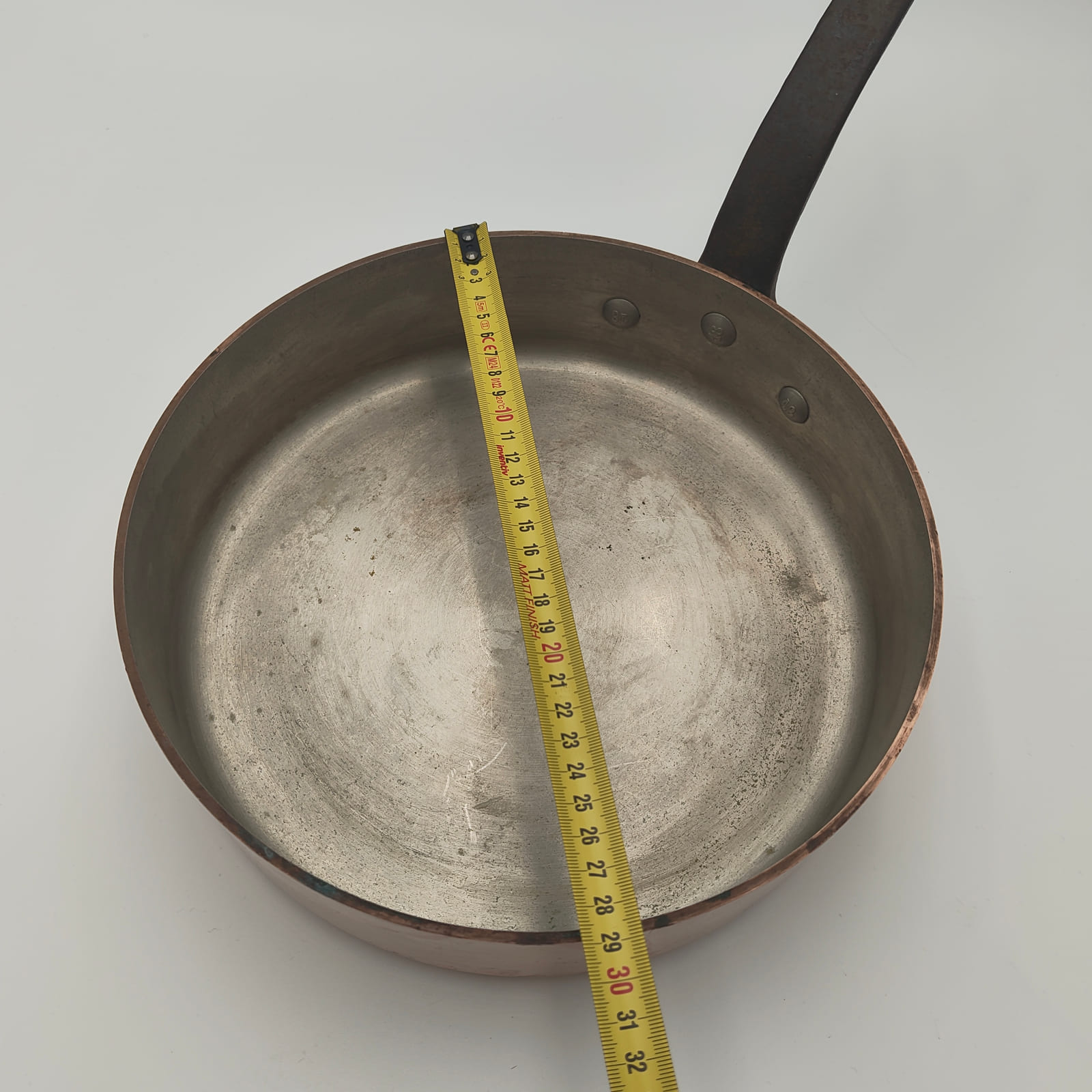
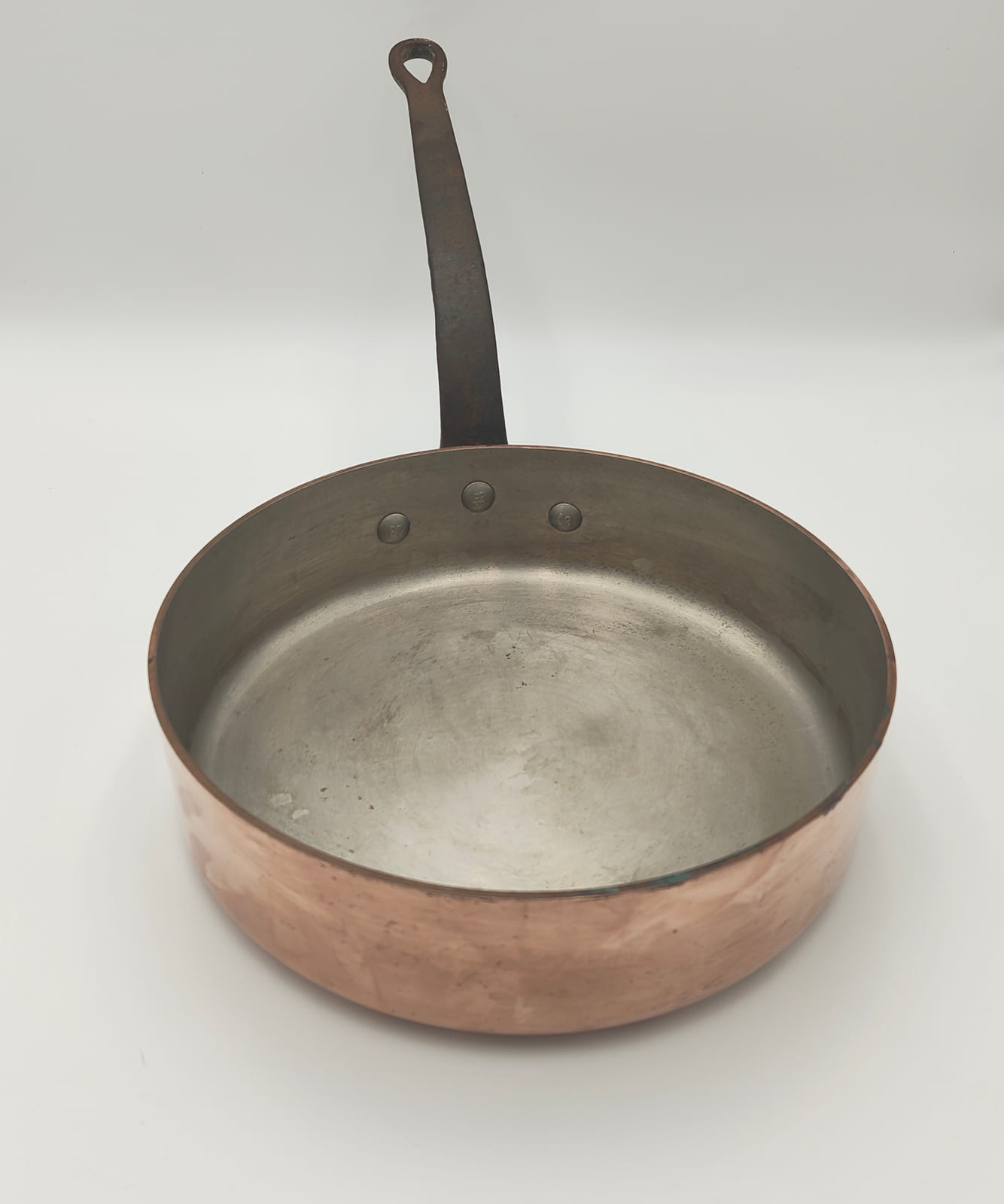
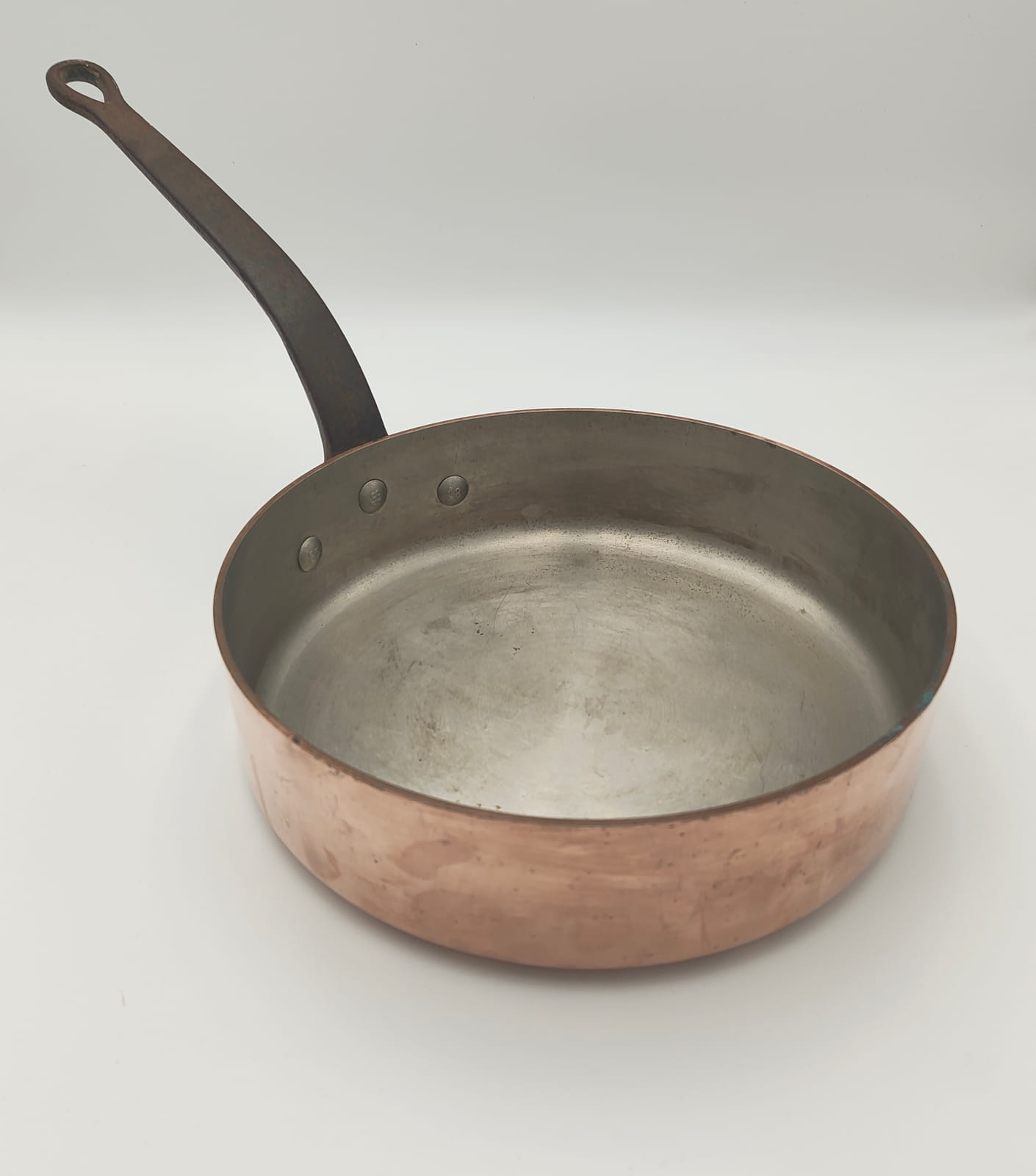
This pan is the heaviest single piece of copper we have handled, and it is a useful teacher precisely because everything about it is measurable. The figures below were taken by us; nothing in them is inferred.
Specifications as measured
- Diameter
- 29 cm
- Weight
- 4.685 kg
- Copper wall
- Approximately 3 mm
- Construction
- Tinned copper
- Handle
- Massive iron handle
- Attachment
- Three large rivets
- Mark
- E. DEHILLERIN / PARIS
- Rivet stamps
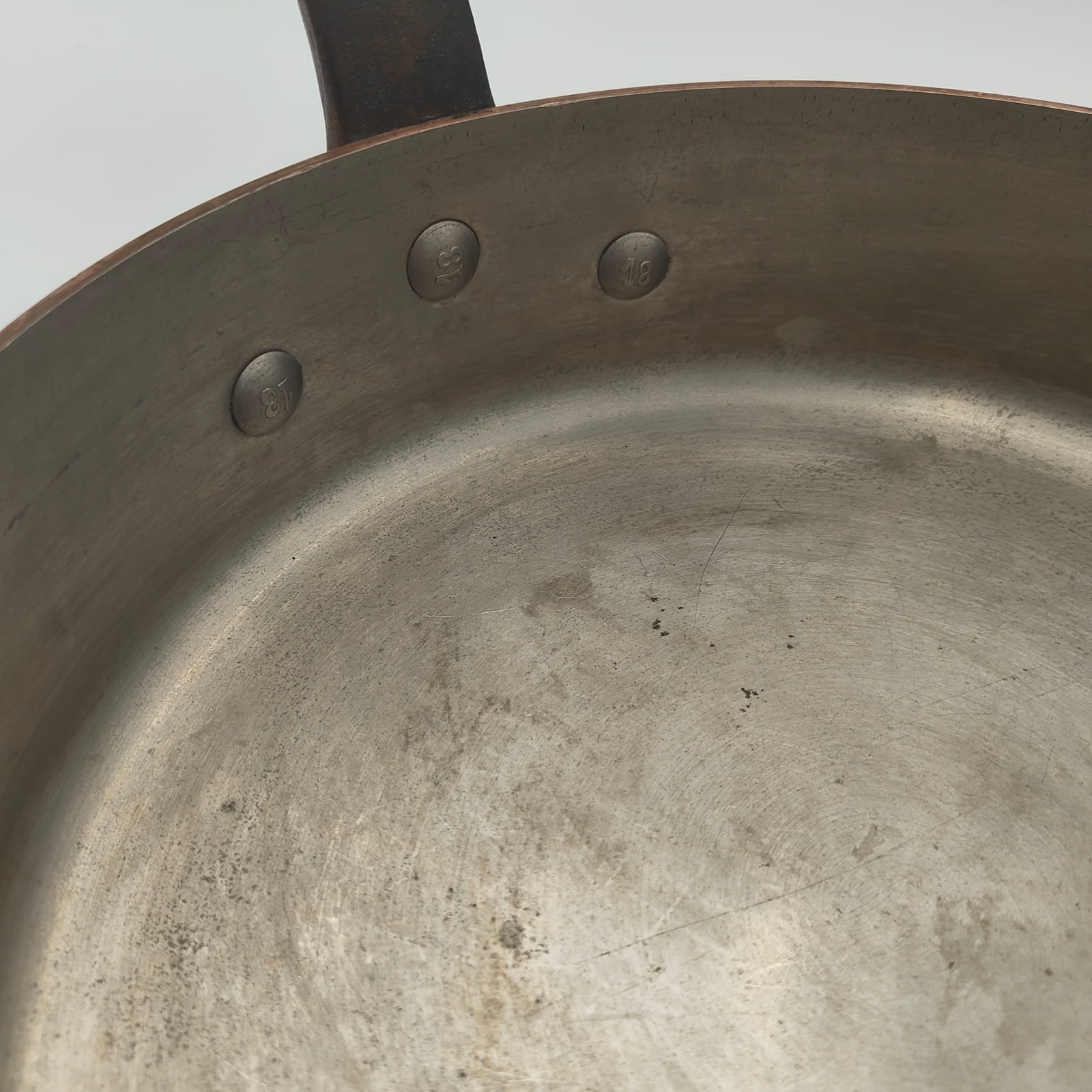
- Each of the three interior rivet heads bears the stamped number “18”
Measured and weighed by Cook & Collect. These are observations, not a date: none of these figures assigns a year of manufacture.
What 29 cm, 4.685 kg and 3 mm actually describe
This is heavy-gauge professional copper. At 29 cm across, with a wall of approximately 3 mm and a weight of 4.685 kg, the pan is built for the thermal stability a working kitchen needs rather than for domestic convenience — it is genuinely difficult to handle one-handed when full. That tells us about the intended use and the class of cookware. It does not tell us when the pan was made. Heavy-gauge copper was produced over a long period and is still produced today, so thickness and weight describe specification, not age.
Reading the mark and the rivets
The pan carries an “E. DEHILLERIN / PARIS” mark, which identifies the Parisian house associated with the object. Each of the three interior rivet heads bears the stamped number “18”; its workshop significance has not been established. We record it because it is physical evidence, and we resist the temptation to explain it: a plausible-sounding interpretation of a stamp is not the same as a documented one.
Collector’s note
A maker’s or retailer’s mark can identify a maker or a house; it does not automatically provide a manufacturing date. Thickness, weight, handle type and rivet construction help us understand how an object was built and used, but none of them should be used on its own to assign a date.
Condition, lining and restoration on professional copper
Pieces of this class were bought to work, and their surfaces record that work: utensil scratches across the base, heat colour on the walls, light oxidation on the iron handle, and tin that has thinned or worn through where contact was heaviest. Tin was always a consumable — the company’s own history records tinning workshops operating within the firm until the 1960s — so periodic retinning belongs to the normal life of such a pan rather than to its restoration.
We describe what is present and resist improving it. Aggressive polishing rounds the edges of a stamped mark and can erase shallow rivet stamps altogether, which on a piece like this would remove the most informative evidence it carries. Where a lining has clearly been renewed, we say so rather than presenting a bright interior as an original surface.
What can and cannot date a Dehillerin piece
The house has traded since the nineteenth century, moved to rue Coquillière in 1890 and ran its own workshops into the 1960s. That frames a long period, and almost every physical feature of a heavy professional pan — thick copper, an iron handle, large rivets, a tinned interior — was produced across most of it. None of those features narrows the period on its own, and combining several of them does not make the reasoning stronger if each is individually uninformative.
What would narrow it is documentary: a dated catalogue showing the pattern and gauge, an advertisement, an invoice, an institutional record, or a piece with a documented commission. Until such a source is located for a given object, we describe the object by its marks and measurements and leave the date open.
Dating this sauté pan
We have not assigned an exact manufacturing date to this pan, and we will not do so on the evidence currently available. What we can say is documented and limited: the object carries an E. DEHILLERIN / PARIS mark; it is tinned heavy-gauge copper of approximately 3 mm; it has an iron handle fixed with three large rivets; and each interior rivet head is stamped “18”. The house itself has traded since the nineteenth century and operated its own tinning and boilermaking workshops into the 1960s, which frames the object without dating it. Narrowing the period would require a period catalogue, an invoice, an advertisement or another documentary record matching this pattern — and that research is still open.
Research in progress
Date of manufacture: not established for this pan. It is described by its mark and its measurements until a documentary source is located.
Research & References
The sources below are those actually consulted for this guide. Physical evidence recorded on the object comes first; documentary sources are cited where they exist, and gaps are stated rather than filled.
- E. Dehillerin
- The house’s own published history, used here for the Halles origins, the 1880s acquisitions (including a tinning workshop and the older shop opened in 1820), the 1890 move to rue Coquillière, and the firm’s own boilermaking and tinning workshops operating until the 1960s:
Where this fits in our French copper research
Reading the Dehillerin mark is one part of a wider method — marks, dimensions, weight, gauge, handles, rivets, lining, base, wear and restoration, examined in that order and kept separate from interpretation. That method, and the general history of French copper, are set out in our pillar guide. Read the main guide to vintage French copper cookware.