French Copper Cookware · Collector’s Guide
Vintage French Copper Cookware: A Collector’s Guide
French copper was made to be used. A sauté pan, a saucepan or a preserving pan was bought to work in a kitchen, and the way it was built — the gauge of its copper, the lining inside it, the handle bolted to its side, the rivets holding that handle, the marks stamped into the metal — was a response to that job. Those same features are what a collector reads today. This guide is built around pieces sourced and examined by Cook & Collect, and it is as explicit about what the evidence does not tell us as about what it does.
The French Copper Tradition
Copper conducts heat quickly and evenly, and it can be raised, hammered and turned into deep, complex shapes by hand. For French professional kitchens that combination made it the standard material for serious cookware long before stainless steel existed, and the trades that supplied it — chaudronnerie (coppersmithing and boilermaking), dinanderie (decorative copper and brass work) and étamage (tinning) — were distinct crafts with their own workshops.
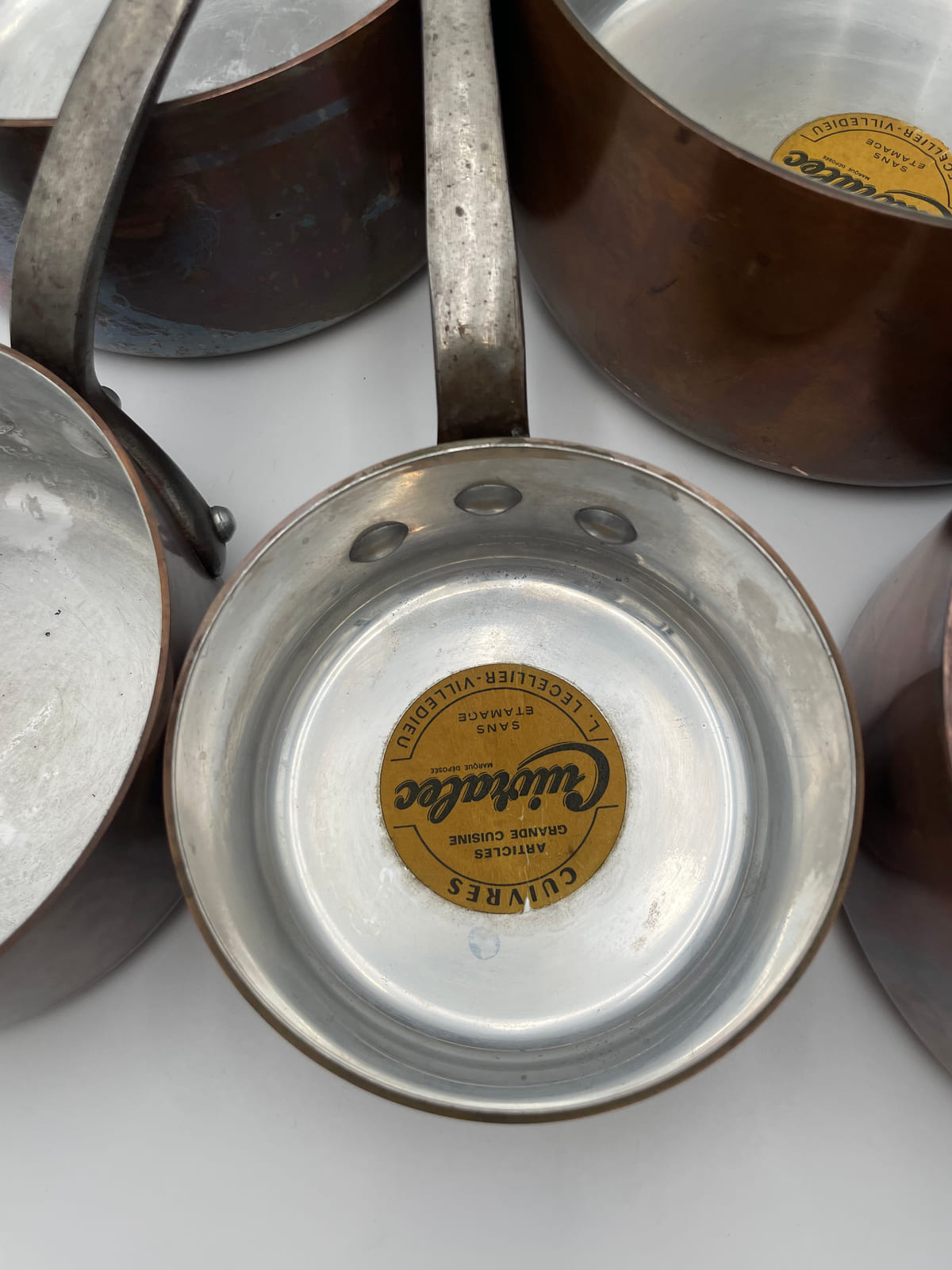
One town is inseparable from that history: Villedieu-les-Poêles, in the Manche department of Normandy. Its name records the trade, and copperworking remains its documented heritage: the town’s municipal museum, the Maison du Patrimoine Sourdin, devotes one of its permanent spaces to the copper craft alongside lacemaking, Norman furniture and contemporary copper and brass production by workshops still active in the area. Mauviel, founded there in 1830 according to the company’s own history, is the best known of those workshops, and L. Lecellier — whose “Cuivralec” mark appears on a graduated saucepan set in our archive — also carried the Villedieu name on its products.
The other pole of the story is Paris, and specifically the food trade around Les Halles, where professional kitchens were supplied. E. Dehillerin grew out of that district and still trades on rue Coquillière. Understanding that French copper reached kitchens through both provincial manufacturing towns and Parisian professional suppliers is the key to reading its marks, because those two roles leave different kinds of evidence on an object.
Makers, Suppliers and Where to Read Further
Three names recur in the French copper we handle, and each one teaches a different lesson about how these objects should be read. Below is a short introduction to each, with a link to the guide where the objects, marks and measurements are examined in full.
E. Dehillerin — the Parisian professional supplier
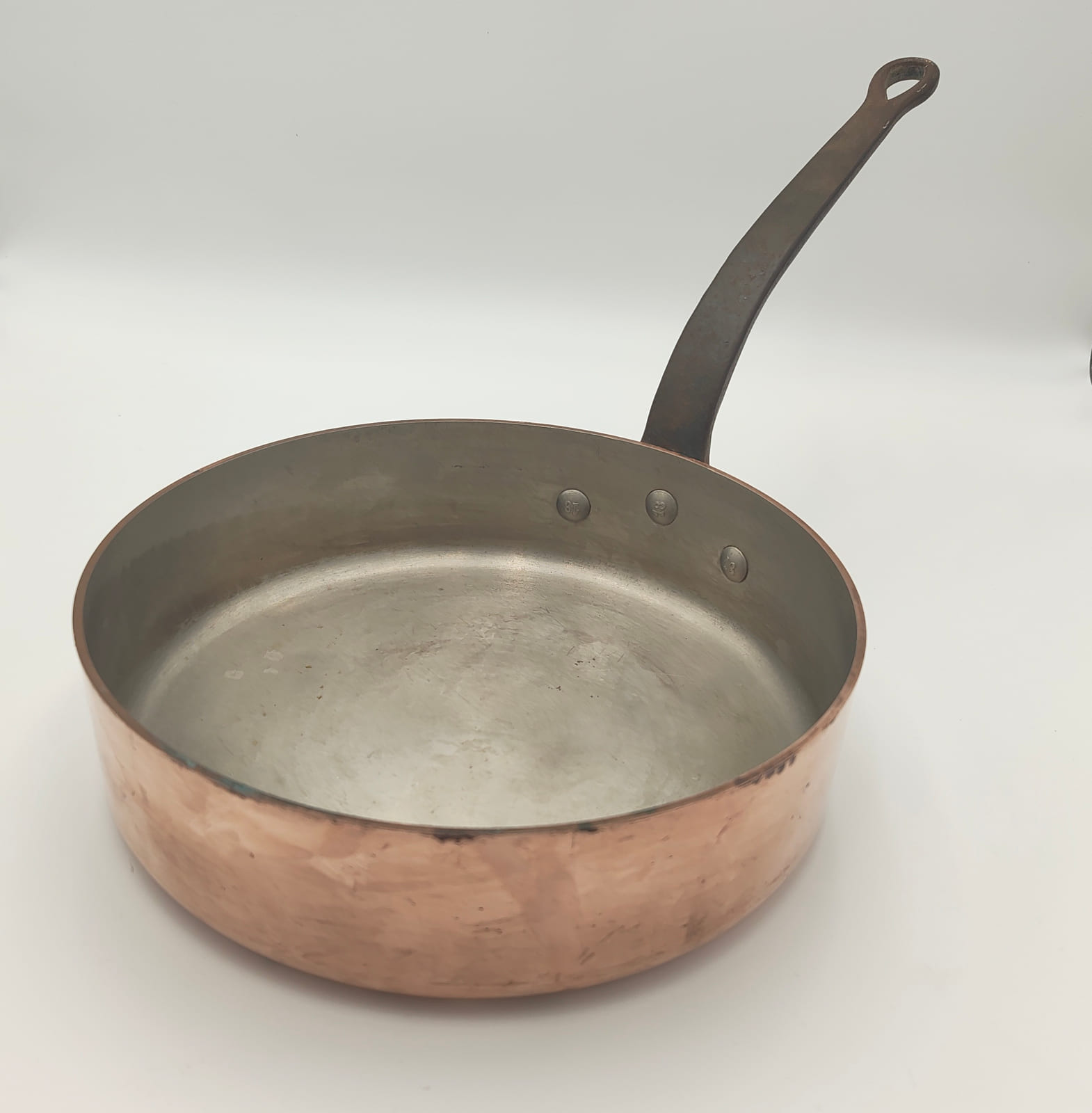
E. Dehillerin grew out of the food trade around Les Halles and still trades on rue Coquillière. It matters to collectors because it occupied both sides of a distinction that is easy to blur: it supplied professional kitchens and, by its own account, also produced in its own boilermaking and tinning workshops. A piece marked “E. DEHILLERIN / PARIS” is therefore firmly associated with the house, without that mark alone settling who formed the metal or when. Our heavy 29 cm tinned copper sauté pan, weighing 4.685 kg with a wall of approximately 3 mm, is the object we use to work through that reasoning.
Mauviel — the Villedieu manufacturer
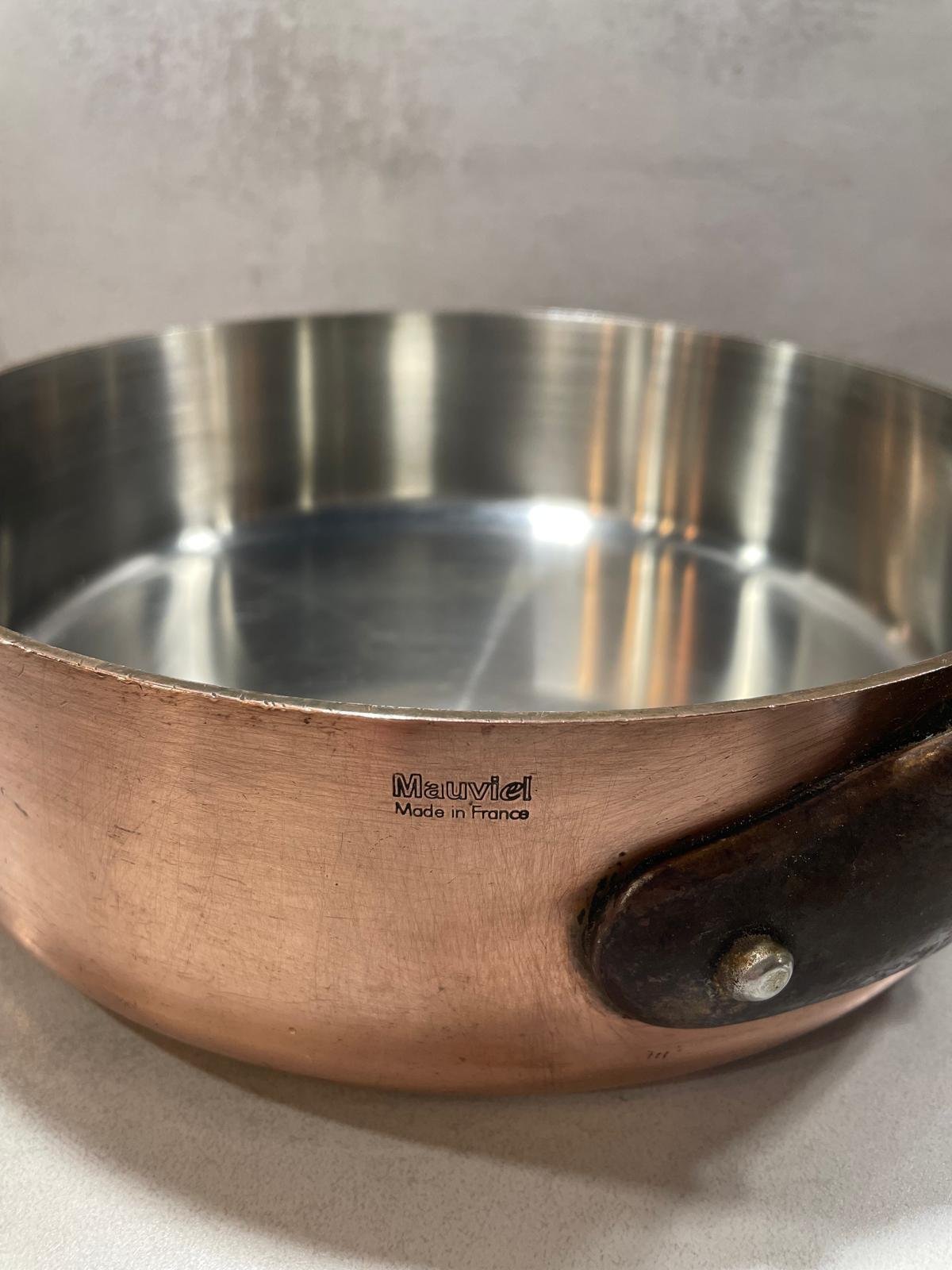
Mauviel is the best-documented of the Villedieu-les-Poêles workshops, and a Mauviel mark is about as clear an identification as French copper offers: it names a manufacturer. What it does not name is a date, a gauge or a lining. The Mauviel pieces that have passed through our hands — including a confiturier that carries both Mauviel and E. Dehillerin references — are the ones we use to separate maker from supplier, and mark from conclusion.
L. Lecellier and Cuivralec — when the label outlives the metal
L. Lecellier also worked at Villedieu-les-Poêles and sold under the registered “Cuivralec” name. The graduated set of five saucepans in our archive is unusual because several pieces still carry their original paper labels — and those labels state something the metal cannot, including the words “sans étamage”, without tinning. It is the clearest example we own of documentary evidence surviving on the object itself.
Reading a French Copper Pan
When a copper pan arrives, we work through it in a fixed order, and we write down what we see before we form an opinion about what it means. The sequence matters, because it keeps physical evidence separate from interpretation.
Marks, dimensions and weight
First, the marks: a maker’s or house name, a town, a country-of-origin stamp, size numbers, and any stamped digits on rivets, handles or the base. Each is recorded exactly as it appears, including where it sits on the object. Then the measurements — diameter, height, wall thickness and weight — taken and noted rather than estimated, because they are the part of the description that can be checked by anyone later.
Handle, rivets and construction
Next the construction: the material and form of the handle, how it is attached, the number, size and placement of the rivets, whether rivet heads are domed or flattened, and how the body has been raised or formed. Also the base — whether it is flat or slightly domed, and how it has worn. These details describe a workshop practice and a class of object, and they are most useful when they are read together rather than one at a time.
Lining and interior surface
Then the inside: whether the pan is tinned, and if so whether the tin is original, worn, patchy or has been renewed; whether the interior is a different material altogether; and how the interior surface relates to the rest of the object. Where the lining is not obviously tin, we say so and leave the material unidentified until it is documented rather than guessing.
Wear, repairs and restoration
Finally the history written on the surface: utensil scratches, heat marks, dents, oxidation on iron fittings, polished-out areas, evidence of retinning, and any repair. Wear from professional use is information, not simply damage, and a piece that has clearly been reworked is described as such.
None of these observations is a date on its own. They combine into a description of how an object was made and used, which is the basis on which a cautious attribution can later be built.
Thickness and Weight: What They Tell Us
Copper thickness is the single most useful specification on a French pan, because it is what the object was chosen for. Heavier gauges hold and spread heat more steadily and stay flat under hard use; lighter gauges heat faster, cost less and are easier to lift. The two sets of pieces we refer to throughout illustrate the range plainly: the E. Dehillerin sauté pan has a wall of approximately 3 mm and weighs 4.685 kg, while the L. Lecellier saucepans are approximately 1.5 mm. Those are different tools for different kitchens.
What thickness and weight cannot do is date a pan. Heavy professional gauges and lighter domestic gauges were made alongside each other, and both are still made now. The same applies to weight, which is simply thickness multiplied by size. Where a gauge is useful for dating is as one element among several — combined with marks, labels, construction and, ideally, a period catalogue or advertisement that shows which gauges a given maker or supplier offered and when.
We avoid rules of the form “3 mm means nineteenth century” or “iron handles mean antique”. Such shortcuts are common in the trade and they are not supported by the evidence; they conflate specification and period.
Handles, Rivets and Construction
Handles on French copper appear in iron, brass, bronze, cast metal and, on later pieces, stainless steel, and their shape follows their purpose: long straight handles for stove work, short ears and side handles on large vessels that need two hands, ring handles for hanging. A heavy iron handle on a heavy pan is a matched pair — the handle has to carry the weight of a full vessel, and the joint is where a pan fails first.
That is why rivets repay attention. Their number, diameter, spacing, and whether their heads are left domed or hammered flush, all reflect how a workshop solved the problem of anchoring a handle to a curved copper wall. The heavy E. Dehillerin sauté pan in our archive is a good illustration — its iron handle is held by three large rivets, each interior head carrying a stamped number — and we examine that construction in detail in the guide devoted to it.
Read together, handle material, handle form, rivet pattern and the way a body has been raised can place an object within a recognisable family of French copper production and can support or undermine a proposed attribution. Read individually, they prove very little — and in particular an iron handle is not evidence of age, since iron was used across a very long period and for straightforwardly practical reasons.
Tin Lining, Wear and Restoration
Traditional French copper cookware is lined with tin. The interior is coated with a thin layer of tin over the copper, which is why étamage was a specialist trade with its own workshops — large Parisian suppliers ran their own tinning shops, as the E. Dehillerin company history records. Tin is soft and does not last forever, so a working pan was expected to be retinned periodically. Retinning is therefore part of normal French copper practice rather than a modern intervention.
On a surviving piece, the lining is one of the more informative surfaces. Original tin usually shows a dulled, slightly mottled grey with utensil marks and thinning where heat and stirring concentrated; copper showing through at the base or on the walls indicates genuine use. A uniformly bright, unmarked interior on an otherwise well-used pan generally indicates professional retinning, which is a legitimate and often desirable treatment — we simply say when we believe it has happened, and we do not present a relined pan as an untouched original surface.
We describe linings, not cooking. Whether a particular vintage piece should be used for food is a decision for its owner, informed by the actual condition of the lining and, where appropriate, by a professional retinner — and we would rather point someone to a retinning workshop than offer reassurance we are not in a position to give.
“Made in France” Is Not a Maker
A “Made in France” stamp is country-of-origin information. It confirms where an object was manufactured and it is genuinely useful — it separates French production from the large quantity of copper cookware made elsewhere — but it names no workshop. On the Mauviel piece in our archive the two appear together, with the maker’s name and the country-of-origin mark doing different jobs; on a great many surviving French pans, only the country mark is present.
Such pieces are perfectly collectable. They are simply unattributed, and they should be described that way: French copper, maker unidentified, with whatever measurements and construction details can be recorded. That is an honest description, and it leaves room for a later attribution if documentary evidence appears.
We do not attribute unsigned French copper to Mauviel, L. Lecellier, Gaillard or any other maker on the basis of visual similarity. Shapes, handle patterns and rivet arrangements were shared across the trade and repeated over long periods; resemblance is a reason to research, not a reason to attribute.
Condition, Patina and Restoration
Copper changes constantly. Exposed to air it darkens, and over decades it develops a patina ranging from warm brown to nearly black, sometimes with green oxidation where moisture has sat. Iron handles rust lightly and darken. Tin dulls and wears through at the points of heaviest contact. A pan that came out of a professional kitchen carries utensil scratches across the base, heat marks and often small dents — a record of the work it did.
All of that can be polished away, and a brightly polished copper pan photographs well. But polishing is abrasive: it removes metal, softens the edges of stamped marks, and can erase shallow markings altogether. Aggressive cleaning of an interior can likewise remove what is left of an original lining. The evidence a collector depends on is thin — often a few tenths of a millimetre deep — and it does not come back.
Cook & Collect therefore prefers to preserve historically informative surfaces rather than automatically return a piece to a new appearance. We clean sympathetically, we leave marks, labels and original linings alone, and where a piece has been retinned or reworked we say so. A buyer who wants a mirror finish can always create one; a removed mark or a stripped label cannot be restored.
How Cook & Collect Researches French Copper
Our method runs in one direction: physical evidence first, then measurements, then construction, then marks and labels, then comparison with documented examples, then manufacturer and institutional sources, then period catalogues and advertisements — and only then a cautious attribution. Working in that order keeps interpretation downstream of observation, which is where it belongs.
It also means separating kinds of evidence as we go. What is physically present on the object, what is documented in a published or archival source, what is an attribution we are proposing, and what is comparative evidence from another surviving piece are four different things, and we try to make clear in our descriptions which one we are relying on.
A date attached to another surviving example is a starting point, not a conclusion.
Where the evidence supports only a broad period, we give the broad period. Where it supports no period at all, we say that too — as with the Dehillerin sauté pan and the Cuivralec set above. For a listing, that restraint can look like a missed opportunity. For a collection built to be trusted, it is the point.
Research & References
Our research combines the physical evidence recorded on each object with official manufacturer histories, museum and institutional sources, and — where we can locate them — period catalogues and advertisements. The sources below are those actually consulted for this guide. Where we have not yet consulted a source, we say so rather than listing a plausible one.
- Villedieu-les-Poêles
- For the town’s copper heritage we rely on its municipal museum, the Maison du Patrimoine Sourdin, whose permanent displays cover the copper craft alongside lacemaking, Norman furniture and contemporary copper and brass work from local workshops. Listed in the Réseau des musées de Normandie:
- Maker-specific sources
- References for individual makers and suppliers are listed on the guide whose claims they support, so that each statement sits beside its source: E. Dehillerin, Mauviel and L. Lecellier / Cuivralec. Where research is still open — as it is for Cuivralec and for the confiturier — those guides say so rather than offering a source we have not consulted.
Collecting Vintage French Copper Today
French copper remains one of the most rewarding fields a collector can enter, partly because so much of it survives and partly because it can still be used. Heavy professional pieces and lighter domestic sets sit at opposite ends of the same tradition, and both can be read — marks, gauge, handles, rivets, lining and wear all tell part of the story. The discipline that makes the difference is being willing to leave the parts of the story that are not yet documented unwritten.
This guide is the starting point for our French copper research. The makers and suppliers introduced above each have their own guide, where the objects, marks and measurements are examined in full, and those pages will grow as the research does. Read our collector’s guide to vintage French Champagne buckets. Learn how Cook & Collect sources and documents its pieces.