L. Lecellier & Cuivralec · Collector’s Guide
L. Lecellier & Cuivralec: A Collector’s Guide
Most vintage French copper reaches a collector stripped of its paperwork, which is why the graduated set of five saucepans in our archive is worth a guide of its own: several pieces still carry their original Cuivralec labels, and those labels state things the metal cannot. This guide sets out the physical evidence on the set, reads the label in full, and is explicit that no production period has yet been established. It forms part of our wider guide to vintage French copper cookware.
L. Lecellier and Cuivralec
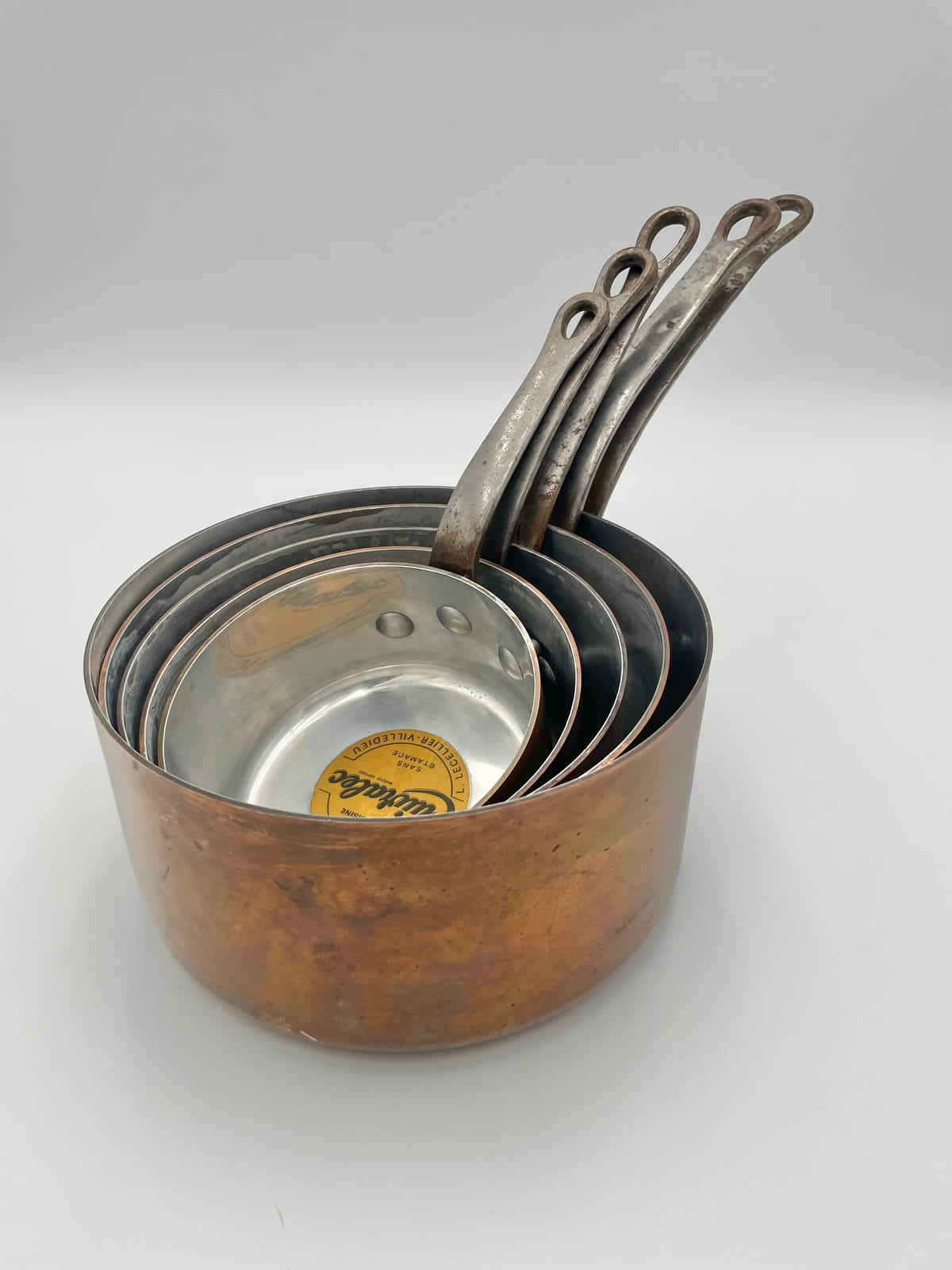
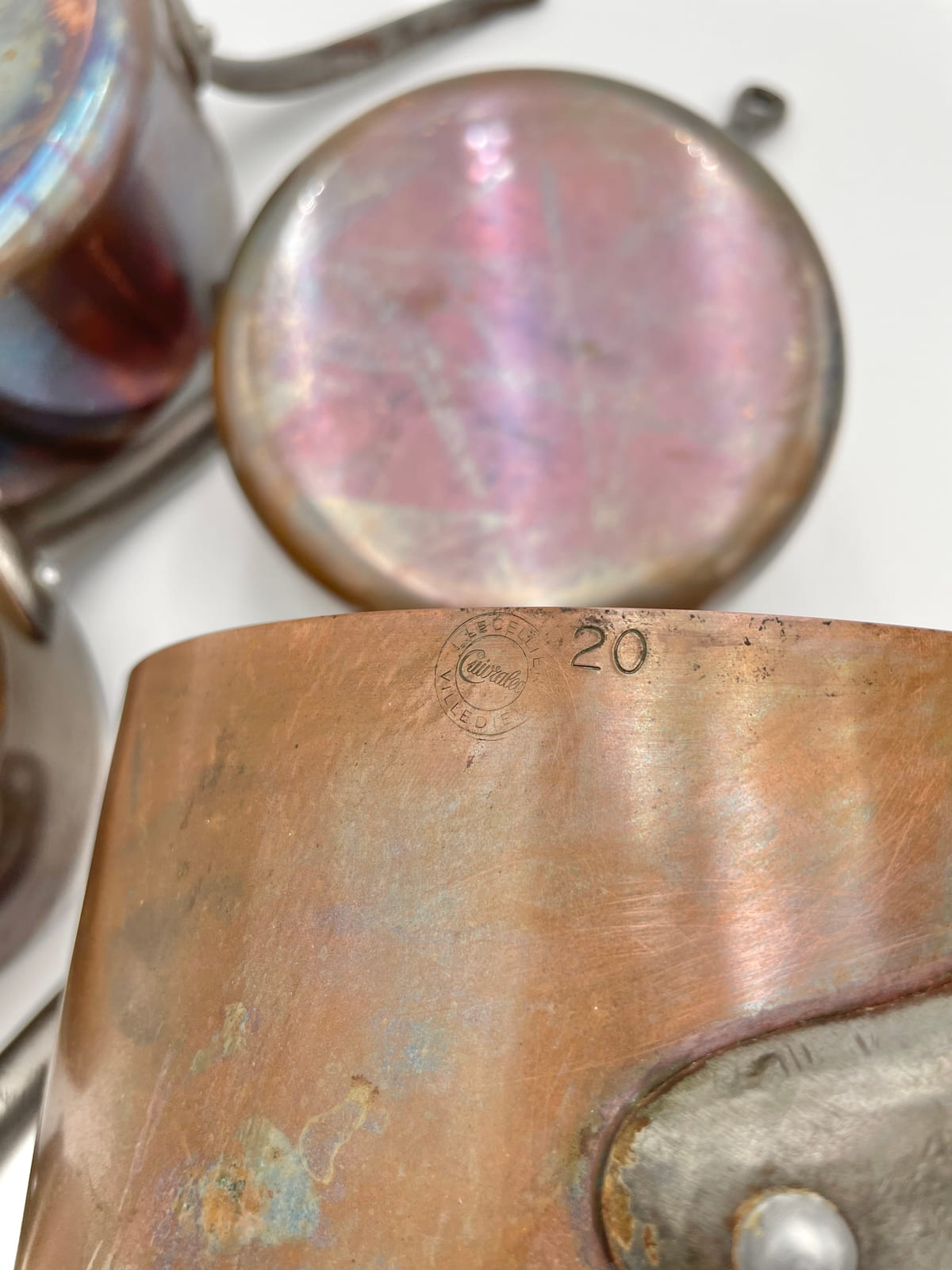
The second principal group in this guide is a graduated set of five French saucepans — 12, 14, 16, 18 and 20 cm — with an approximate copper thickness of 1.5 mm. The largest saucepan carries an L. Lecellier / Cuivralec / Villedieu maker’s mark; the other pieces carry size markings. Several retain their original paper labels.
The mark ties the set to Villedieu-les-Poêles, the Norman copper town discussed above, and “Cuivralec” is presented on the label as a registered trademark (“marque déposée”). Beyond that, we are deliberately brief: we have not yet consulted a documentary source for the firm’s history or production period, and so we do not offer one.
Which pieces are marked
Only the largest saucepan, the 20 cm, carries the L. Lecellier / Cuivralec / Villedieu maker’s mark. The remaining four carry size markings rather than a maker’s name. That pattern is worth stating precisely, because a set is easily described as “all marked” once one piece is: the four smaller saucepans are attributed to the same range by the marked piece, the surviving labels and their shared construction — which is an attribution, not a mark.
Collector’s note
One piece of the five is maker-stamped. The others are attributed on the basis of the marked saucepan, the original labels and matching construction, and we describe them that way rather than implying five maker’s marks.
A graduated set of five saucepans
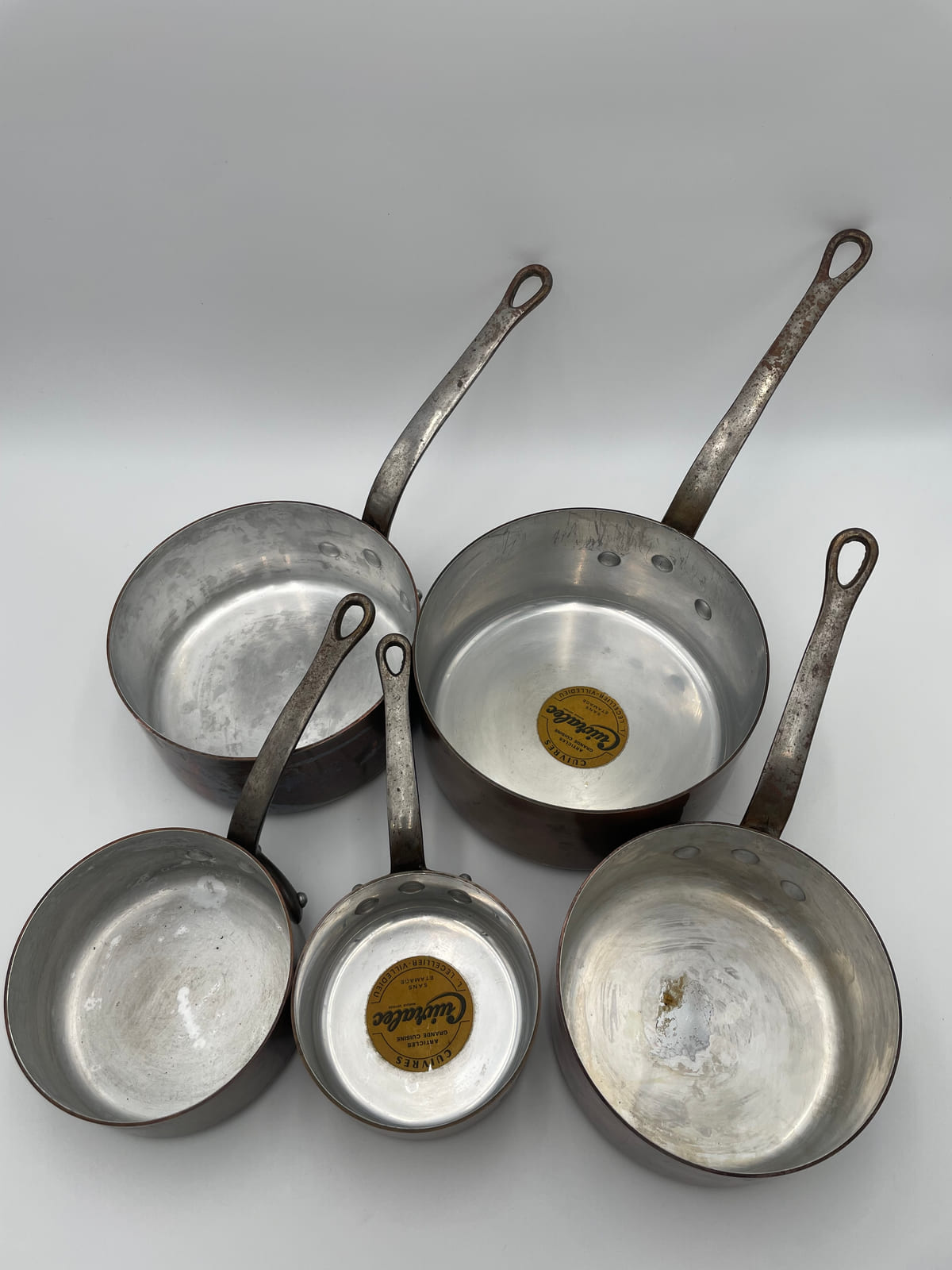
The five sizes run 12, 14, 16, 18 and 20 cm, with a copper thickness of approximately 1.5 mm — a lighter gauge than the Dehillerin sauté pan, and a range of sizes that makes sense as a working progression rather than as a display arrangement. We describe it as a graduated set of five saucepans, not as a complete five-piece set: whether five was the original commercial configuration is a question a period catalogue could settle, and until one does, claiming completeness would overstate what we know.
Physical evidence and historical attribution
It is worth separating the two plainly. The physical evidence here is strong and checkable: the mark on the 20 cm saucepan, the size markings on the others, an approximate copper thickness of 1.5 mm, the construction, and the surviving printed labels. The historical attribution — who L. Lecellier was, when the Cuivralec range was made and sold, how it was positioned in the trade — rests on documentation we have not yet consulted.
Both belong in a description, clearly labelled. A set can be precisely documented as an object and still be undated as a product, and saying so is more useful to a collector than a confident period that no source supports.
Why an original label matters
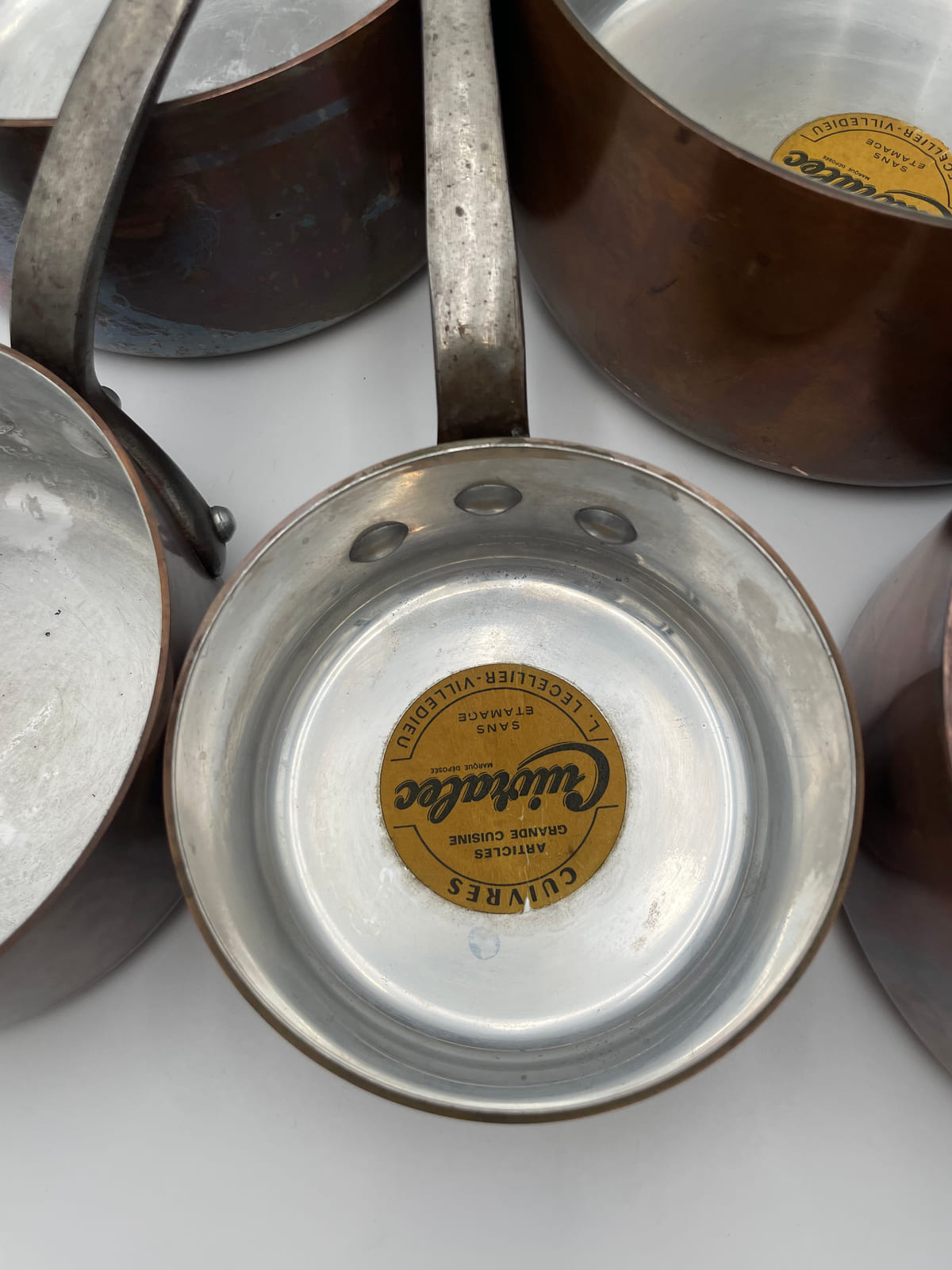
A surviving paper label can state things the metal cannot. A stamped mark gives a name; a label can give the product range, the trade the pieces were sold for, a trademark claim and, crucially, a statement about how the pieces were finished. Labels are also fragile — they are washed off, scrubbed away or simply worn out — so a set that retains several of them preserves evidence that is usually the first thing to disappear.
Collector’s note
Because labels are printed rather than stamped, they describe how a product was sold. That is a different kind of evidence from the object’s construction, and both are worth recording separately.
“Sans Étamage”
The most interesting wording on the Cuivralec labels is the phrase “sans étamage”. Transcribed in full, the label reads:
Original label, transcribed
Cuivres · Articles Grande Cuisine · Cuivralec · Marque Déposée · Sans Étamage · L. Lecellier – Villedieu
Transcribed from the original paper labels surviving on the set. The wording is quoted exactly as printed.
“Étamage” is tinning, so “sans étamage” means literally “without tinning”. Read plainly, the label tells us these saucepans were sold without the traditional tin lining, and that this was presented to the buyer as a feature of the product rather than as an omission. For a set of copper “articles grande cuisine”, that is a genuinely informative statement: it means the interior finish was intended to be something other than tin, and that retinning was not part of their expected maintenance.
What the label does not say is what the interior material is. We are not identifying it here. Published claims about untinned French copper linings exist, but we have not verified any of them against a manufacturer document, a period catalogue or laboratory analysis of these pieces, and an unverified material claim on a cooking surface is exactly the kind of statement that should not be guessed.
Dating the Cuivralec set
No production date is assigned to these saucepans. The physical evidence is the L. Lecellier / Cuivralec / Villedieu mark, the size markings, the approximately 1.5 mm copper and the surviving labels with their “marque déposée” and “sans étamage” wording. A trademark registration record would give a documented reference point for the mark, and a period catalogue or advertisement would do the same for the range; neither has been consulted yet. Until then the set is described by its marks and measurements alone.
Research in progress
Production period: not established. We have not consulted a period catalogue, an advertisement or a trademark registration for Cuivralec, and we do not offer a date in their absence.
Research & References
The evidence for this guide is primarily the object itself: its mark, its size markings and its surviving original labels. Documentary research is still open, and the entry below says so rather than citing a source we have not consulted.
- L. Lecellier / Cuivralec
- Research in progress. Our evidence at this stage is entirely physical: the L. Lecellier / Cuivralec / Villedieu mark on the largest saucepan, the size markings on the others, and the surviving original labels with their “marque déposée” and “sans étamage” wording. We have not consulted a manufacturer, archival or museum source for the firm’s history or production period, and we have not verified the trademark registration; the INPI historical trademark archives are the avenue we intend to pursue. We deliberately list no source here rather than cite marketplace listings.
Where this fits in our French copper research
Gauge, handles, rivets, linings and wear are read the same way on a Villedieu saucepan as on a Parisian sauté pan, and the broader history of the French copper trade — including Villedieu-les-Poêles itself — is set out in our pillar guide. Read the main guide to vintage French copper cookware.